
If AI Writes Your Code, What Exactly Are You Paying Engineers For?
If you cut engineering headcount this year because AI writes the code now, there's a chance you cut the only part that was still expensive.
You might notice I keep touching the cost of AI, because leaders and organizations who rode the AI/LLM wave are now grappling with ground realities, except the ground is sand and it keeps slipping away: their budget.
Every business (traditional or not) understands variable costs, sure, but those costs move with revenue. Sell more, spend more. And tech organizations have a decade of experience with subscription pricing, which was predictable by design. Almost nobody has dealt with a cost that rises with enthusiasm rather than revenue, which is what this one does.
Uber rolled Claude Code out to its engineering organisation in December 2025, roughly 5,000 engineers. By February, 32% were using it. By March, 84% were classified as agentic coding users. By April, the company had burned through its entire 2026 AI budget, four months into a twelve-month plan. The spread is the part worth sitting with: average spend ran $150 to $250 per engineer per month, power users ran $500 to $2,000, and Uber's own CTO reported spending $1,200 in a single two-hour session.
That isn't a story about Uber being careless. It's a story about a budget line that was built correctly, using a cost model that had quietly stopped being true, and rolled out without spend controls because nobody had needed spend controls on a developer tool before. Moving forward this is going to be the reality of most businesses, not just tech.
Across the market, enterprise AI spend is up 108% year on year, averaging $1.2 million per organisation, and 78% of IT leaders report charges they never budgeted for. At the same time, headcount growth expectations have dropped from 6% to 2%, while roughly three quarters of CFOs are increasing technology spend. The easy reading is substitution: buy tools, hire fewer people. I don't think that's what the numbers say, and the rest of this piece is my argument for why.
In several of my clients' teams, and in my own, AI now writes something like 85% to 99% of the lines that ship, at around $320 per developer per month for an SME. That's higher than Uber's roughly 70%, and I think the reason is unglamorous: smaller teams, mostly greenfield, not much legacy to work around, and service boundaries we can still afford to be lenient about. The percentage is a function of how much history the code has, not how good the tooling is. Although every AI transformation project that I took on started with the same statement: That this is not a plan to reduce headcount or for you to pay less to your employees. Today, I've had to answer a question I never had to answer before, and I had to answer it in a spreadsheet, in front of a board: if the thing my engineering budget used to buy has become nearly free, what is the money actually buying now?
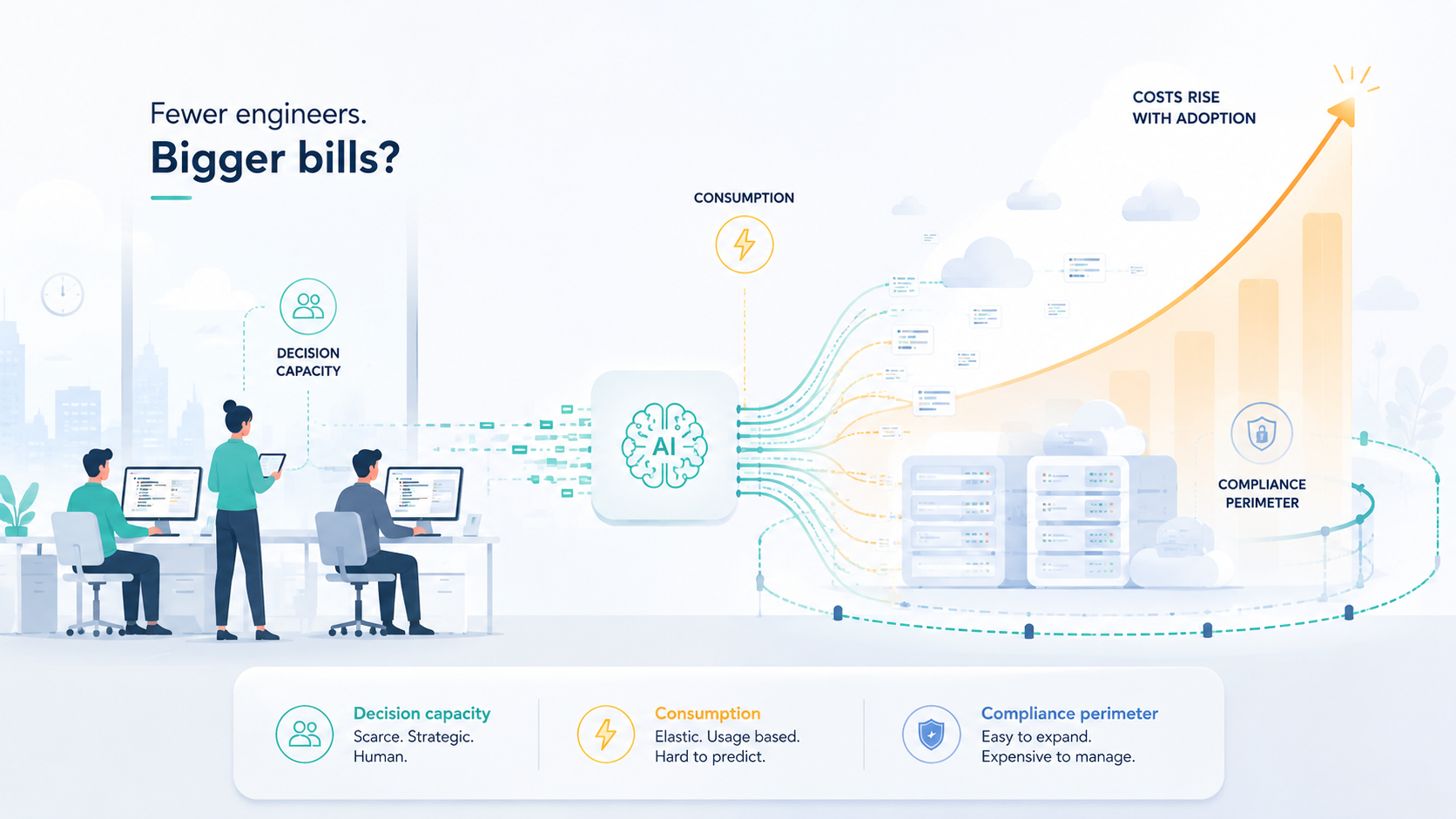
Here's the model I ended up with. Three buckets. The point of splitting them is that each behaves completely differently: different volatility, different owner, different failure mode. Keeping them in one line item is precisely how organisations get blindsided.
Bucket 1: Decision Capacity (Fixed, and Your Real Constraint)
For thirty years, engineering headcount was a proxy for output. I mean, remember when outsourcing companies would invoice you with LOC (lines of code) as a line item? More engineers, more code, more product. Crude, but it forecast well enough to plan against.
That proxy has broken. Code generation is no longer the bottleneck. What's left as the constraint is the work AI doesn't do: deciding where logic lives, what talks to what, what sits inside the compliance perimeter, which trade-off is acceptable, and reviewing what came out.
This is the bucket that determines whether the other two produce value or waste. It's also the one most likely to be cut first, because on paper "AI writes the code now" reads like a headcount saving.
The budget question here isn't how many engineers. It's what is our ratio of review-and-decide capacity to generation capacity? If you doubled output and held review flat, you didn't buy all of the gain you booked. You bought some of it, on the low-risk changes, and on the rest you built a queue, and queues in engineering don't show up as visible delays. They show up as things merged without anyone senior really looking.
A practical test for your next planning cycle: take a recent quarter and ask what fraction of shipped changes had a senior human make a genuine architectural judgement about them. If nobody can answer, that's your finding. Whatever that number is, it's what your fixed engineering budget is now buying, and it should be defended like payroll, because it is payroll.
Bucket 2: Consumption (Variable, Uncapped by Default, and the One That Bites)
This is the bucket that ate Uber's year.
Seat licences were predictable: multiply a price by a headcount. Consumption pricing is not that. It scales with usage, usage scales with adoption, and adoption is the thing you spent all of last year encouraging, I know I did. Success and overrun are the same event. That's part of why 78% got surprised. Nothing went wrong, exactly. The tool worked, people used it, and the invoice turned out to be a function of enthusiasm. There's a second driver underneath it that I rarely see discussed. In the teams I've watched, once nearly all the code is generated, devs stop feeling ownership of it, which is natural. They don't know the lay of the land so to speak. So they reach for the agent to change even a single variable, because reading the file themselves now feels like the slower option. Every one of those is a paid call.
Three controls, all of which you can put in place this quarter without a transformation programme.
A cap per person, per tool, per month. Not a target. A limit, with a visible dashboard and a named person who approves exceptions. Uber's numbers show why you can't set this from an average: typical spend was $150 to $250, power users were at $500 to $2,000. The average tells you almost nothing about what the month will cost. The right number for you falls out of your own usage data after a single month of measurement, and it has to be set against the tail, not the mean. The figure isn't the point; converting an unbounded line item into a bounded one is the point.
An owner for every agent. Every autonomous agent running in your business should have a name attached, and that person should be able to answer three questions: what it does, what data it touches, and what breaks if it's switched off. In OutSystems' 2026 enterprise survey, 94% of leaders reported concern about agent sprawl: agents accumulating with no inventory. Take the number with the usual vendor-survey pinch of salt, but the direction matches what I see. Sprawl isn't primarily a security problem. It's an unowned cost centre that also happens to be a security problem.
Agent sprawl is a symptom of a deeper problem I would like to get into in another article.
A unit cost, not a total. "We spent $200k on AI" is unactionable at board level. "It costs us $X per merged change" or "$Y per resolved support case" is a number you can trend, compare, and defend, and it's the only form in which this spend can be honestly measured against the headcount it supposedly replaces.
Bucket 3: Compliance Perimeter (Annual, Non-Negotiable, Set by Engineering Decisions)
The third bucket never appears in AI budget discussions, and over time it's the one I've seen cost the most.
I was doing unrelated work for a client when I noticed a reporting server in their architecture that should have been the least interesting box on the diagram. It held no card data at all. It just had a connection open to a system that did.
That connection is the whole story. PCI DSS covers everything that stores, processes, or transmits card data, plus every system connected to it. Scope is not set by where the card numbers are. It is set by what is wired to what.
So that unremarkable reporting server was inside their assessed environment, and so was the tooling hanging off it. Each of those systems had to carry access control, logging, patching, encryption with documented key management, scanning, testing, and evidence produced annually, in a form an assessor accepts. Nobody had decided to buy any of that. An engineer had opened a connection years earlier, for a perfectly good reason, and the bill had been arriving every year since.
The same structural logic now reaches well beyond payments. DIFC's Regulation 10, covering personal data processed through autonomous and semi-autonomous systems, has been in force since September 2023 and reached full enforcement on 1 January 2026. The EU AI Act entered its enforcement phase on 2 August 2026, when the bulk of the regulation became applicable, transparency obligations under Article 50 among them, carrying penalties up to €15 million or 3% of global annual turnover. The high-risk rules most people were bracing for actually slipped: after the Digital Omnibus amendments, Annex III high-risk obligations now apply from 2 December 2027, and high-risk AI embedded in regulated products from 2 August 2028. Which is its own budgeting lesson. The date moved, your connectivity graph didn't. Operating in the UAE means navigating a layered regime (federal PDPL, DIFC, ADGM, Abu Dhabi) where the same deployment can fall under different rules depending on which square kilometre it runs in.
The budget consequence is the part executives miss: an engineer creating a connection between two systems, for perfectly good performance reasons, can add systems to your compliance perimeter that cost money every year, forever. Nobody signs that off as a purchase. It simply appears in next year's audit.
So the control is a question, asked before the connection is made rather than during the assessment: what does this pull into scope, and what does it cost us annually? One question, added to a design review you already run. It's the cheapest budget control I know of, and almost nobody has it.
The Three-Question Review
If you take nothing else from this, take these into your next planning cycle:
- What is our ratio of decision-and-review capacity to generation capacity? Fixed bucket: protect it.
- What is our cost per unit of output, and who owns each agent? Variable bucket: cap it, own it, trend it.
- What did we add to our compliance perimeter this year, and who approved that cost? Annual bucket: govern the connections, not just the systems.
The first two you can answer inside a month. The third usually takes longer, because most organisations have to map the connections before they can count them, and that mapping is itself the finding. All three are defensible to a CFO in language they already use.
The Trap Worth Naming
The tempting move right now is to treat AI productivity as a headcount saving and cut. I'd be careful.
What AI removed was the cost of producing code, and producing code was never where the expensive failures came from. They came from decisions: logic split across layers with no declared owner, a service boundary deleted for a performance win, scope quietly expanded by a connection nobody reviewed.
Cut the people who make and check those decisions and you don't get a leaner organisation. You get one that produces bad architecture at unprecedented speed, and finds out about it eighteen months later: during due diligence, or an audit, or a market launch that was supposed to take two weeks.
Budget for the constraint that actually exists, not the one that used to.
Although I'll be honest about the limits of my own position here. I don't know what the right ratio of decision capacity to generation capacity is. I've argued for protecting headcount in rooms where the numbers on the slide genuinely did point the other way, and I'm not certain I was right every time. Cap consumption too aggressively and you throttle the one thing that is clearly working. Protect roles too broadly and you're defending sentiment rather than a constraint. Both of those are real mistakes, and I've made them in the same year.
So I'd rather ask than conclude. If you've reduced engineering headcount on the back of AI productivity, how did you actually measure that it worked, and how long did you wait before deciding? I haven't seen that done convincingly yet, which either means it's early, or it means I'm wrong about the constraint. I'd like to know which.
Originally published on antequity.net
Refrences: