

Accountability in AI integrated Product Teams
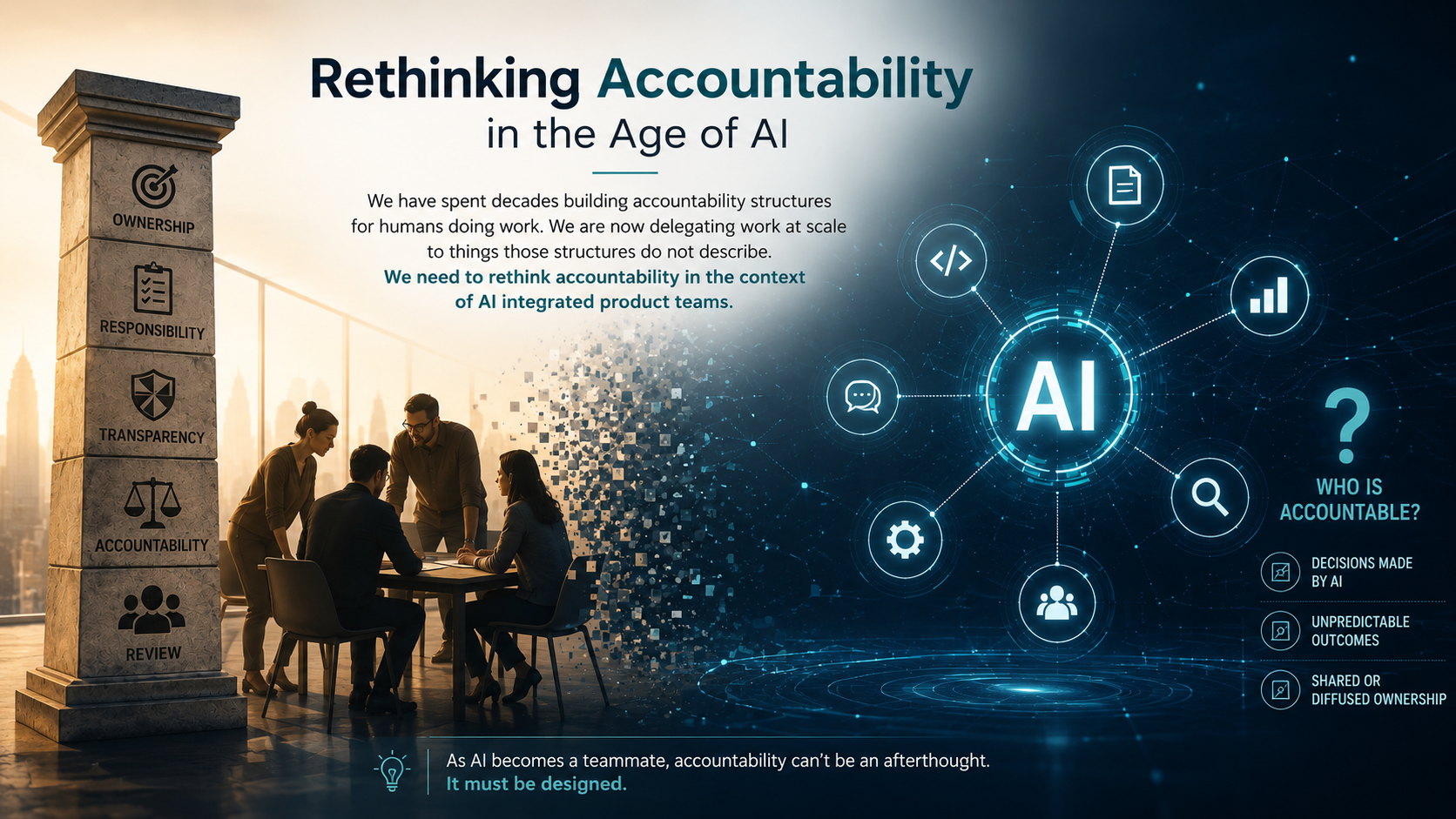
We have spent decades building accountability structures for humans doing work. We are now delegating work at scale to things those structures do not describe. We need to rethink accountability in the context of AI integrated product teams.
In my last piece on engineering budgets I mentioned agent sprawl and then deliberately walked past it, saying it was a symptom of something deeper that deserved its own article.
When a person joins your company, a lot of machinery/process activates. There is a contract. Somebody is named as their manager. Access is provisioned deliberately, and someone signs off on the level of it. They appear on an org chart. When they leave, another process runs: access is revoked, responsibilities are reassigned, and somebody checks that nothing they owned quietly fell on the floor.
When an agent joins your company, none of that happens. It gets created inside a sprint, given credentials that were convenient at the time, and pointed at production. There is no contract, no manager, no org chart entry, and critically no offboarding process, because nothing ever tells you the agent is finished.
We have spent decades building accountability structures for humans doing work. We are now delegating work at scale to things those structures do not describe, right?
Why This Accumulates Without Anyone Deciding (or noticing)
Nobody (not-including LLM Bros) sets out to run forty unmanaged autonomous processes. Sprawl happens because every individual agent arrives as a side effect of something reasonable.
A team automates a reconciliation step. Someone builds a support triage assistant for their own queue, it turns out to be useful, so it stays. A data pipeline gets an agent that classifies incoming records. Somebody in DevOps wires one up to summarise infra health every morning. Each is a good afternoon's work, and each one quietly ends up holding an access token with no expiry and more scope than it needs. None of them is a hiring decision, so none of them goes through anything resembling one.
Then the person who built it changes team, or leaves. In this region, where average technical tenure runs two to three years (due to outsourcing/contract), that happens sooner than most planning assumes. The agent keeps running, because that is what it was built to do. It keeps holding credentials, keeps touching data, and keeps costing money, and now nobody in the building can tell you why it exists.
Sprawl is not really an inventory failure, I mean sure it looks like one, but in my opinion it is not. Because if it was the solution is simple: Keep an inventory. The deeper problem is what happens when you delegate authority to something that cannot be held accountable, and then never decide who is accountable in its place.
The Agent That Changed How I Think About This
It started as a good idea from a senior manager. He looked at a financial dashboard every morning, which is a dull way to start a day, and asked whether an agent could just send him the summary instead, with follow up questions when a number looked odd. Entirely reasonable, and it got built quickly. An MCP server over the reporting data, read tools only, a scheduled summary each morning, a chat interface for the follow ups. Nobody treated it as a hiring decision. It looked like a convenience.
Then the follow up questions got more ambitious, insights rather than lookups, so write capable tools were added to the same server over the following weeks. Each one on request. Each one individually sensible. None of them going back through the approval the read only version had. What had been signed off as a summariser was now something else, and nothing anywhere recorded the change.
Then he stopped using it. He drifted back to the dashboard, and the daily message became something he no longer opened. The agent did not notice, because nothing about it was built to notice. It kept running every morning, pulling financial data, generating its summary, holding write access to production, for months after the last human read a word of its output.
Nobody found it by looking for agents. It surfaced during an ordinary AWS audit, someone going through the account working out what was running and what it cost. What they found was a scheduled job firing every morning that nobody could account for: no owner tag, no ticket, no mention in any runbook. Following it to the IAM role is where it stopped being housekeeping, because the permissions were far wider than a daily report needs. Those were the write tools, added one request at a time, months earlier, by people being helpful. At audit time it read as a scheduled process with production write access and no owner, which is a genuinely alarming thing to find and an accurate description of what it was.
Working out whose it was took the longest. The person who built it had been a temporary resource. The manager who asked for it had stopped reading the output and did not think of himself as owning anything; when we asked, he assumed the tech team was taking care of these tools. Nobody was hiding anything, nobody had done anything unreasonable, and it still took days to establish that this thing running against production belonged to nobody at all.
What bugs me is how it was caught. Not a governance review, not a security process, not anyone whose job included knowing what autonomous systems we operate. A cloud audit found it, months late, by accident, and only because the agent had an infrastructure footprint that someone, me as it happens, eventually walked into. Had it been running on a SaaS automation platform, or on the laptop of the engineer who built it, there would have been no scheduled job to notice and no role to follow. It would still be running now.
The Black Box
The LLM bill for those months is the least interesting thing about that story, and it is the thing most organisations would notice first.
But there is a subtler problem, and it was there from day one, before the write tools and before the abandonment.
The dashboard was the source of truth but now an agent sat between the source of truth and the person deciding from it.
Now what he was reading was no longer the numbers. It was a narrative about the numbers, produced by a system that cannot tell you how it arrived at the narrative. When the summary said the month looked fine, there was no way to interrogate what "fine" had been weighed against. Now what he was reading was no longer the numbers. It was a narrative about the numbers, produced by a system that cannot tell you how it arrived at the narrative. When the summary said the month looked fine, there was no way to interrogate what "fine" had been weighed against. Was the convenience was real? most definitely but so was the layer of interpretation sitting exactly where the accountability was supposed to be.
Generalise that, because it is not a quirk of one badly governed reporting tool. When an agent does something that matters, can the person accountable for it explain why it did that?
For deterministic automation, accountability story works because the decision is reconstructable.
An LLM based agent does not give you that. The same input can produce a different output on a second run. Ask the model to explain its own reasoning and you get text that reads like an explanation but is generated after the fact, by the same process that produced the decision, with no privileged access to it. It is a plausible account, not an audit trail. Treating it as evidence is a category error that will eventually be made in front of a regulator or a customer.
So the owner of an agent is accountable for decisions they cannot fully reconstruct. That is a genuinely new position to put a manager in, and I do not think most governance frameworks have caught up with it, including the one I am describing.
What follows from that, practically, is that accountability has to move forward in time. If you cannot audit the decision afterwards, the only place left to exercise control is before it: what the agent is permitted to touch, what it can do without a human confirming, what gets logged at the moment of action rather than reconstructed later, and where the hard stop sits. Blast radius stops being a security field and becomes the primary accountability field, because it is the last thing about the system you can still state with certainty.
This is also the part where I expect disagreement. One reading is that this makes agents unsuitable for any decision that has to be defensible, and that the honest move is to keep them out of those paths entirely. But on the other hand, I think, that we already accept exactly this with humans, since a person cannot reconstruct their own reasoning either, they produce a plausible account after the fact too, and we hold them accountable regardless through outcomes, constraints, and review rather than through introspection. I lean towards the second, with the caveat that a human who cannot explain a decision can at least be asked again tomorrow and will remember making it. I would like to hear the case for the first.
What A Register Actually Contains
I want to be careful here, because "maintain an inventory" is the kind of advice that sounds responsible and changes nothing. A list that nobody uses is worse than no list, since it creates an illusion of control. Another sheet in an ever growing list of sheets.
The test I use is simple. For every autonomous system running in the business, one named human should be able to answer four questions without preparation.
What does it do, in one sentence, in business terms. If the only available description is technical, the owner is the person who built it rather than the person accountable for it. Those are frequently not the same person, and the second one is what you need.
What data and systems does it touch. Read and write, separately, because the gap between those two is exactly where the dashboard agent went wrong. This is also the field anyone from outside asks about first, whether that is an auditor, an acquirer during due diligence, or your own board.
What breaks if it stops. This is the question that reveals which of your agents have quietly become load-bearing. Some will turn out to be running a step that a customer-facing process depends on, without anyone having designed that dependency.
What is the worst thing it can do if it behaves badly. Not what it does. What it is permitted to do. This is the blast radius from the last section, and of the four it is the field doing the most work, because it is the one thing about the system you can still state with certainty. An agent that can only read is a different risk from one that can move money, change entitlements, or send a message to a customer under your brand.
Then two administrative fields that matter more than they look: what it costs per month, and when someone last confirmed it should still exist.
Offboarding Is The Half Everyone Skips
Registers get built. Then they rot, because organisations treat this as an onboarding problem and it is at least equally an offboarding one.
Humans leave. Agents do not. Nothing tells you an agent has outlived its purpose, so unless someone explicitly checks, it will run for years past the project that justified it. It holds credentials the whole time. If it was given broad permissions during a rush, it still has them.
So the field I would defend hardest is the review date. Every agent gets a date by which its owner has to confirm it should still be running. Miss the date and it gets disabled rather than deleted, which sounds harsh but is the only mechanism I have found that works. Deleting things scares people into permanent inaction. Disabling them produces an immediate, honest answer about whether anyone needed them, usually within a day.
How To Start Without A Programme
This does not need a transformation initiative, nothing fancy, and it does not need a new tool.
Run an amnesty first, ask every team to declare what they are running, explicitly with no consequences attached, because the moment declaring something creates work for the declarer you will get a clean and fictional list. Expect the total to be higher than you assumed. Mine was.
Then put the register where the work already happens. We use Jira, not because it is elegant for this, but because everything the register needs is machinery Jira already has and everyone already uses. One issue per agent, in its own project. The assignee is the owner, which means it is a real person with a real name and it changes hands through the same process every other assignment does. The description carries the four questions, and answering them is the definition of done for creating the agent. Custom fields hold what it touches, its blast radius, and its monthly cost. The due date is the review date.
That last mapping is the one that makes it work. A review date in a spreadsheet is a note. A due date in Jira is a thing that goes overdue, appears on a board, shows up in a filter, and nags somebody. A JQL filter for agents past their review date is the whole governance report, and it takes about a minute to write. An automation rule moves anything overdue into a Pending Disable state, notifies the owner, and gives them a week before the credentials go. Then we just Prune using a bulk transition on a filter. Easy.
Reviews then stop being an event. The owner gets a ticket, confirms it should still exist, sets the next date, closes it. If nobody responds, the workflow does the disabling, which is exactly the point of putting it in a tool that acts rather than a document that sits there.
We want to gate agent creation, but not usage. New agents get an owner and a review date at the point they are created, which is the only moment when someone actually knows what the thing is for. Retrofitting ownership later can get cumbersome, it is how you end up with 50 thread chain mail asking three teams whether a service belongs to them.
What I Am Still Unsure About
I do not know what the right level of granularity is. Register every agent and the list becomes unmaintainable within two quarters, which is the failure mode of every asset inventory I have ever seen. Register only the significant ones and you have to define significant, which is precisely the judgement call people get wrong, since the agent that causes the incident is rarely the one anyone flagged as important.
I also suspect the manager analogy breaks down somewhere. A manager who cannot explain a report's decision can ask them. An owner of an agent has accountability without that, and without anything resembling the influence a manager actually has. Naming an owner may turn out to be a way of assigning liability while quietly leaving accountability unassigned, which would make the register a worse artifact than having none.
So two questions I would put to anyone running a technology organisation. How many autonomous systems are running in your business right now, and did you answer that with a number or with a range? And if one of them made a decision that cost you a customer this morning, who would explain why, and would you believe the explanation?