

Is Your Job Safe in the Age of AI?
As AI continues to take on more tasks traditionally done by humans, many are questioning the security of their jobs. Here's what you need to know.
Which Skills Actually Survive AI?
I was consulting at a fintech startup, working with a group that had nothing to do with finance. One afternoon I was at a senior accountant's desk, chatting about nothing in particular. Then he asked me if his job was safe.
It caught me off guard, since finance was not in my remit and I had not interviewed anyone on his team, had no real reason to be near their work at all. But word travels, and the company was spending real energy on automation. Everyone knew what that usually means.
He had reason to ask, because we had just rewritten the hiring plan for the data analytics team. Twenty people were on it already, and the plan had been to add four every quarter. The revised plan added two a year.
I told him what I actually knew, which was nothing about any plans for his team, and then I told him the thing I tell every employer I work for, that I do not see an AI transformation as a way to blindly cut headcount. He let me finish. Then he said that was not what he was asking. He meant the profession. Did I think accountants were going to be replaced.
That is a harder question, and I did not have an answer for it. What follows is the answer I have worked out since.
Nobody stops you in a corridor to ask about your AI adoption roadmap. They ask whether they are going to be fine. And every answer on offer is either reassurance with nothing behind it, or a reskilling list written by someone who sells reskilling.
I sat down to write this sure I already knew the answer. The plan was to write it down and be done. Then the research complicated it. Almost everything I looked at to back the obvious answer undercut it instead, and the piece turned in a direction I had not planned to take it.
So I went looking for a skill that actually survives. Almost nothing does. What survives is not a skill at all.
Why the Standard Lists Fail
Every future-proof skills list says the same four things: creativity, critical thinking, emotional intelligence, complex problem solving.
Creativity
This is the one I would push back on hardest, and not in the direction you would expect. I do not think models threaten human creativity. What they expose is that most of our work never required creativity in the first place. And that is fine. Creativity comes in bursts, and the bursts are far apart. Most of our time is spent doing routine things over and over again. Creativity is still there. It is just rare, the way it always was, and you cannot build a whole role around something like that.
Critical thinking and complex problem solving
Critical thinking is not a soft skill anymore. It is the thing reasoning AI models are explicitly optimised for, release after release. Complex problem solving is now the literal job description of an agent. That is the loop it runs: break the problem down, try a path, check the result, try another.
Emotional intelligence
Emotional intelligence is the one I cannot call, and it is worth showing you why rather than picking a side. Ayers and colleagues, writing in JAMA Internal Medicine (Ayers et al., 2023), took 195 real patient questions from a public forum and set physician answers beside ChatGPT's. Licensed clinicians, blinded to which was which, preferred the chatbot 79% of the time, and rated its answers empathetic or very empathetic in 45% of cases against under 5% for the doctors. The obvious reading is that the skill is already gone. It is not that simple, because the chatbot wrote roughly four times as much, and researchers reviewing the study for the Science Media Centre noted that the preference narrows once you control for length (Science Media Centre, 2023). The raters were also clinicians rather than patients, reading a forum rather than sitting in a room.
Then there is what happens when the label is visible. Rubin and colleagues ran nine experiments across more than six thousand people, taking identical AI-written responses and telling some participants a human had written them (Rubin et al., 2025). The human-labelled version was rated more empathetic every time, and merely suspecting that AI had helped was enough to lower the score. Wenger, Cameron and Inzlicht put their result in the title of their paper (Wenger et al., 2026): people choose to receive human empathy despite rating AI empathy higher. So both things hold at once. The warmth is real, and people still want it to have cost someone something.
None of this tells you whether people will pay for the human version or just prefer it. Preference is not purchasing power. A customer who would rather talk to a person can still be routed to a machine because the machine is cheaper, and these are laboratory studies of short written exchanges, not workplaces. I have laid the evidence out because I do not think I can settle it for you.
Where this leaves the list
The point is not that these four are worthless. They are just the wrong place to hang your safety.
The Test That Actually Works
I use one question instead of a list, and I should say up front that the idea is not originally mine.
Stop asking whether an AI agent can do your job. Ask what it costs to check its answer.
Everything in this article comes out of that one swap: the work that survives is the work whose answer is expensive to check, long after it is done.
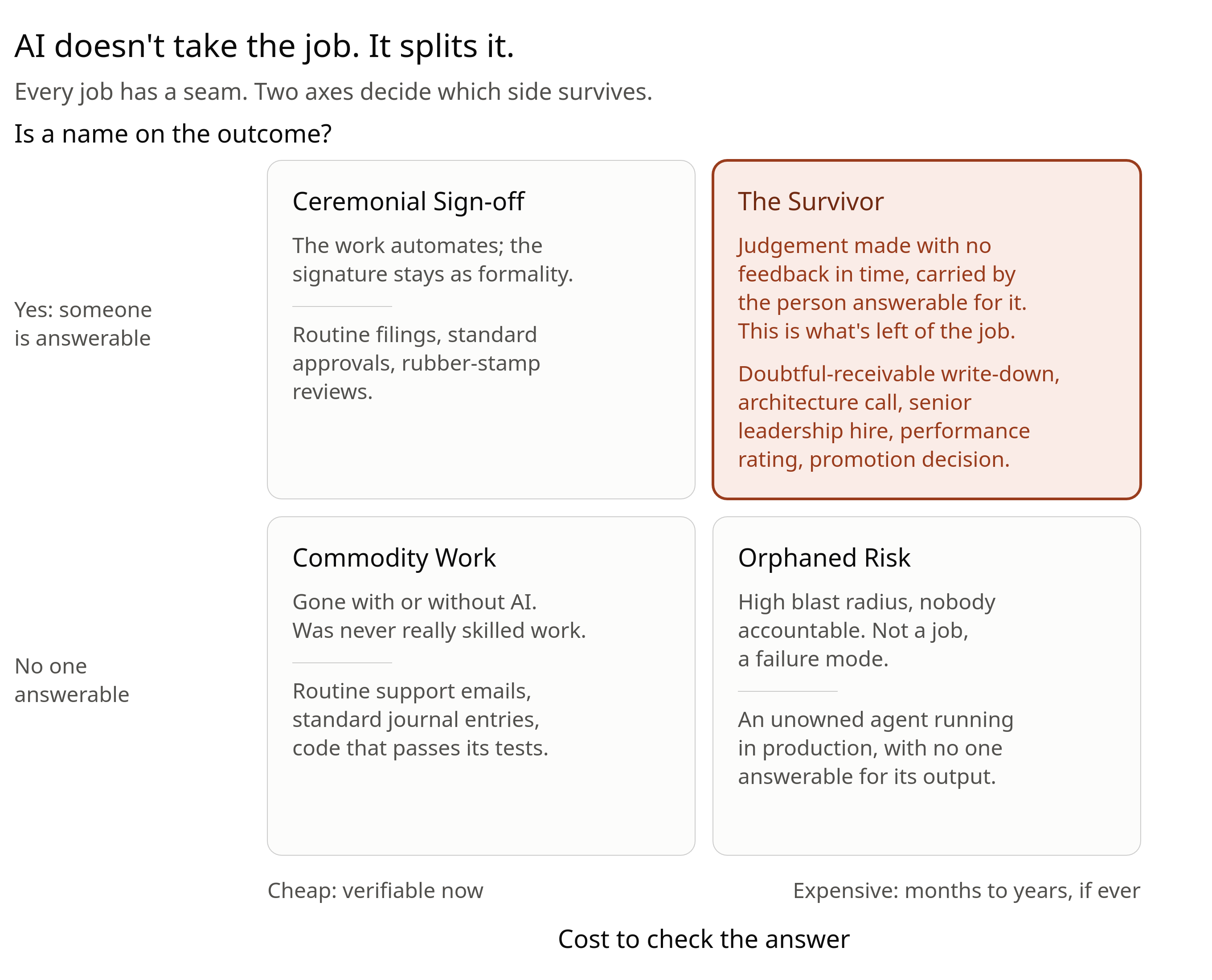
Writing a function is cheap to check. Run the tests, read twenty lines, done in minutes. It does not matter how good the person who wrote it is. Similarly, Answering a routine support email is cheap to check too. Does it address what the customer asked, are the order number and the refund amount right, does it read politely. A minute against the original ticket and you know. The checking is cheap either way, so the task is commodity work already, whether or not anyone used AI to produce it.
Deciding who to hire is not cheap to check. You find out whether you were right maybe one month later or sometimes a year later, and even then not really, because you never get to see how the person you passed over would have worked out. Economists have had a name for this since 1973, when Darby and Karni called them credence goods (Darby & Karni, 1973), the ones whose quality you cannot judge even after you have bought them and used them. A hiring decision is a credence good you are selling to your own employer. That gap, between doing the work and knowing whether it was right, is what decides whether a skill survives.
Run the test on the accountant I opened with. Plenty of his week is close mechanics, reconciliations and standard entries and tying out schedules. That is the cheapest checking there is, because the ledger either balances or it does not and you know before you go home, and it was commodity work long before anyone trained a model on it. What is left is the judgment: how much of a doubtful receivable to write down, whether a cost this quarter is an asset or an expense, whether revenue on a half-finished contract can be booked yet. Those are numbers he books and signs, not calls anyone else makes for him. Nobody can check them the day he makes them, though maybe that is only true today. You find out when the auditors push back, or when the customer folds eighteen months later and someone asks who signed the number. Same person, same week, same job title, and the test cuts straight through the middle of it. Which is why "will accountants be replaced" was the wrong shape of question, and why I could not answer it standing at his desk.
The gap between doing the work and learning whether it was right also decides whether you ever get good at it. Kahneman and Klein found that expertise only forms where feedback arrives fast enough to learn from (Kahneman & Klein, 2009). So the work that is hardest to check is also the work you are least certain you are any good at, because the feedback that would tell you never arrives in time. Most writing about AI arrives at the same place from the other direction, arguing that once producing the work is cheap, the value shifts to whoever can tell whether it is right.
What I have not seen anyone do is turn it on their own week. So try it: write down five things you did, then for each one, ask how long it would take you to find out you got it wrong. Under a day, and that task is commodity work. Months or years, and that is what is left of your job.
Survivor One: Accountability
In a recent article I wrote about how an AI agent kept running for months and nobody knew who the owenr was or what it did. The whole failure came down to one missing name: nobody could say who was answerable for what it did.
That same missing name is the thing that keeps your job.
Accountability does not survive because models decide badly. They increasingly decide well. It survives because a model cannot be the answerable party. Someone has to be the name under the outcome, the person who sits in the room afterwards and takes the question. "The agent decided" is not an answer, and it is not going to become one.
Take an example. An AI tool screens the quarter's applications and hands you a shortlist of eight. The criteria match the role, the reasoning looks sound, you approve it and the interviews go ahead. Four months later a rejected applicant points out that the filter had screened out nearly everyone who listed a career break, and the pattern holds when someone checks. There is a review now, and a group of people in the room who are answerable for how the company hires, not the tool. Nobody will accept "the software ranked them," and nobody will accept "the criteria were standard" either. The question on the table is why you approved the shortlist, and that question was always going to land on a person.
Notice what changed and what did not. That shortlist used to take maybe a days worth of reading applications and now it takes an hour, so you are signing off ten a month instead of two. Your output went up fivefold and so did your exposure. What went down is the time you have to look at any one of them.
Your role does not shrink as the work underneath it gets cheaper. It gets heavier. More of what you are answerable for now comes from systems that cannot explain themselves.
Survivor Two: Judgement When the Data Will Not Arrive
This is not "analyse this dataset", which is commodity work now. It is what you do when the analysis that would settle the question is not going to arrive in time, and you know it, and the clock is running anyway.
Three in the morning, error rate climbing, dashboards disagreeing with each other. You can roll back, or you can wait twenty minutes for the picture to clear. Rolling back costs a day of work and might not even be the problem. Waiting might cost the weekend. Nobody in the room can tell you which, and nobody ever will. If you roll back and the errors stop, you still will not know whether they would have stopped on their own. The counterfactual never shows up. That decision is not waiting on data, it is waiting on you.
A model trained on finished decisions has no feel for that moment. It cannot tell you when waiting stops being diligence and starts being avoidance. That judgement is about risk and the cost of delay, and it barely exists in any training set, because organisations record what they decided and almost never record why they stopped waiting.
The Knowledge Nobody Wrote Down
Neither survivor is a skill you can go and learn, and neither stands on its own. Both run on the same thing: a close sense of how your particular organisation and its systems actually behave (culture), built from years of watching them and recorded nowhere.
Why the last migration actually failed. Which vendor overpromises, and by how much. Which stakeholder blocks every project in month three, no matter what the roadmap says. Which subsystem lies when it is under load.
That last one is why you can call the rollback at three in the morning. You are not reading the dashboards better than anyone else in the channel. You have watched that service behave badly before, and you know which of its signals to believe. And the same knowledge is what separates being accountable from being a scapegoat. Sign off on a decision in a domain you do not understand, and your name on it is not accountability. It is just exposure.
None of this is written anywhere. Not in a ticket, not in a wiki, not in any data training set, because writing it down honestly is usually political.
Which is the thing worth watching, and I have spent real effort trying to move it. I have built integrated comms backed by a retrieval system to capture exactly this, the reasoning that normally evaporates somewhere between a discussion and a decision. The retrieval turned out to be the cheap part. Capturing context honestly means asking people to write down things they have career reasons not to write down, so what you are deploying is not a system, it is a culture change. And it is not a one-time cost. Someone has to keep agreeing to pay it, year after year.
So this system erodes at the speed an organisation will pay for candour, its not hinged on how the LLM models improve. I do not know what that rate is anywhere except the places I have worked. What I do know is that this is not a third survivor standing beside the other two. It is the ground both of them stand on. If it goes, so do they.
The Uncomfortable Part
Neither of these can be learned on a course. You get accountability by being in the room when something goes wrong and staying there, and you collect the context underneath it the same way, by being around long enough. Both come from exposure to consequence, and that takes time.
I should be clear that this is my opinion and not my field. I build systems, I do not study how people acquire skills, so I went looking for whether anyone has established it properly. What I found is not comfortable for me.
The version of my advice that circulates in corporate training is the 70-20-10 rule, which holds that 70% of development comes from doing the job, 20% from other people and 10% from formal teaching. Clardy reviewed the evidence for it and titled the paper "a fact in search of evidence" (Clardy, 2018). The ratio traces back to roughly two hundred executives being asked to recall how they believed they had learned. It gets repeated everywhere and rests on very little.
The harder number is not much kinder. Quiñones and colleagues pooled forty-four datasets covering nearly twenty-six thousand people and put the correlation between work experience and job performance at about .27 (Quiñones et al., 1995). Experience matters. It matters considerably less than the people telling you to go and get experience tend to imply.
And the sharpest objection comes from the paper I leaned on earlier. Kahneman and Klein's condition is that experience only converts into expertise where the feedback is good enough to learn from (Kahneman & Klein, 2009). The two things I have spent this article calling survivors are exactly the places where feedback is slow or missing. You find out about the architecture call in eight months. You never find out about the rollback. By their standard these are close to the worst available conditions for building the judgement I am telling you to go and build.
Which raises the obvious objection, and it is the one I would make myself. Those papers are from 1995 and 2009. Does experience mean the same thing now, when most of what a senior person used to know is a search or a prompt away?
Partly it does not, and somebody has measured it. Brynjolfsson, Li and Raymond followed 5,179 customer support agents through the rollout of an AI assistant (Brynjolfsson et al., 2025). Output rose 14% on average. For the novices it rose 34%. For the experienced agents it barely moved at all. The mechanism they identify is that the system captured what the best people knew and handed it to everyone else, which is the experience premium being compressed in public, on a real workforce, three decades after Quiñones.
So the objection lands. But notice which half of the job it lands on. Resolving support tickets is checkable work, and by the test I set out earlier it was commodity work before the AI assistant ever arrived. What that study measures is the transferable half of experience being commoditised, which is not a rebuttal of this article. It is the commodity half of its argument, confirmed with numbers I did not have.
So experience was really two things wearing one word.
One is what you know. How the pipeline works, who owns which service, what the runbook says when the alert fires at two in the morning. That is information, and a good enough tool can now hand it to someone in their first week at the job.
The other is what you have been through. The migration you approved that cost somebody their weekend. The rollback you called wrong. The sign-off you are still explaining a year later. That one is not information. It is what it cost you to be wrong, and you cannot hand it to anyone.
The 1995 number measured both at once and could not tell them apart. Only the first one is being commoditised. Nobody has gone back to measure what the second is worth on its own, and I am in a poor position to ask, having built one of the systems that takes what the experienced people know and hands it to everyone else.
This forces a concession to the list I opened by dismissing. You can go and work on critical thinking. You can take the course that promises creativity and come out no worse off. The two things I am pointing you at offer nothing like that. They cannot be studied, the feedback that would sharpen them barely arrives, and most people will never be handed a role that builds them. As things to practise, the standard list is the stronger one. It just never answered the question the accountant asked, which is whether any of it keeps him employed.
So what do you do with that? Less than I would like. You cannot enrol in exposure to consequence, and you cannot vote yourself into the room where the decisions get made. What you can do is take the parts of the job you already have that put your name on an outcome, and move toward them rather than away. Take the on-call rotation. Run the incident review instead of just sitting in it. When someone asks you for a recommendation, give one you would still defend in six months, and make sure it is on the record as yours.
Relationships matter now more than ever!
That is not a plan, and it does not scale. Most jobs in most companies do not carry that weight, and no amount of volunteering rewrites the org chart. The honest answer to the accountant is that the thing which survives is scarce by design, that not everyone gets to hold it, and that this is exactly why the comfortable version of this advice, the reskilling list and the four future-proof skills, is a lie. That is as far as I have got. What it means for the people it leaves out, I do not know.
The accountant wanted a yes or a no. The honest answer is that his question had the wrong shape. Half his job, the reconciliations and the filings and the work that ties out or does not, was commodity work before either of us walked in, and that half is going. The other half is the call nobody can check for eighteen months, carried by the person whose name is on it. That half was never what anyone meant by "high-skill". It was never on the list, and it may be the whole job now.
So the phrase was always a proxy. It ranked work by how hard it was to do, in an age when hard to do and hard to replace were the same thing. That age is ending.
Ultimately, What is left when the skill gets cheap is more than a job and less than a profession, and it needs a name before it shows up on a spreadsheet as a line to cut.
References
Ayers, J. W., Poliak, A., Dredze, M., Leas, E. C., Zhu, Z., Kelley, J. B., Faix, D. J., Goodman, A. M., Longhurst, C. A., Hogarth, M., & Smith, D. M. (2023). Comparing physician and artificial intelligence chatbot responses to patient questions posted to a public social media forum. JAMA Internal Medicine, 183(6), 589–596. https://doi.org/10.1001/jamainternmed.2023.1838
Brynjolfsson, E., Li, D., & Raymond, L. (2025). Generative AI at work. The Quarterly Journal of Economics, 140(2), 889–942. https://doi.org/10.1093/qje/qjae044
Clardy, A. (2018). 70-20-10 and the dominance of informal learning: A fact in search of evidence. Human Resource Development Review, 17(2), 153–178. https://doi.org/10.1177/1534484318759399
Darby, M. R., & Karni, E. (1973). Free competition and the optimal amount of fraud. The Journal of Law and Economics, 16(1), 67–88. https://doi.org/10.1086/466756
Kahneman, D., & Klein, G. (2009). Conditions for intuitive expertise: A failure to disagree. American Psychologist, 64(6), 515–526. https://doi.org/10.1037/a0016755
Quiñones, M. A., Ford, J. K., & Teachout, M. S. (1995). The relationship between work experience and job performance: A conceptual and meta-analytic review. Personnel Psychology, 48(4), 887–910. https://doi.org/10.1111/j.1744-6570.1995.tb01785.x
Rubin, M., Li, J. Z., Zimmerman, F., Ong, D. C., Goldenberg, A., & Perry, A. (2025). Comparing the value of perceived human versus AI-generated empathy. Nature Human Behaviour, 9(11), 2345–2359. https://doi.org/10.1038/s41562-025-02247-w
Science Media Centre. (2023, April 28). Expert reaction to study comparing physician and AI chatbot responses to patient questions. https://www.sciencemediacentre.org/expert-reaction-to-study-comparing-physician-and-ai-chatbot-responses-to-patient-questions/
Wenger, J. D., Cameron, C. D., & Inzlicht, M. (2026). People choose to receive human empathy despite rating AI empathy higher. Communications Psychology, 4(1), Article 19. https://doi.org/10.1038/s44271-025-00387-3