

Getting started with AI: Building the foundation
In this part, we delve into the foundational aspects of AI, exploring the key concepts and frameworks necessary for effective implementation.
Part 1: The Four Pillars of AI Success
Organizations are complex, living, breathing, and evolving like the world around it. The inter-connectedness(is that a word?) of various aspects of organizations are well studied and simplified in frameworks such Mckinsey’s 7s. This inter-connectedness means that each part of an organization affects others, they can be force multipliers, conversely they can also drag your organization down. Any change or transformation within the organization must be aimed at improving business domains which in turn can help business achieve its BIG goals.
So based on goals, choose which business domain you want to improve using AI based on which would have the biggest impact. For my research I chose to focus on 3 domains of an organization:
- Organizational Capabilities
- Strategic Leadership
- Human Capital.
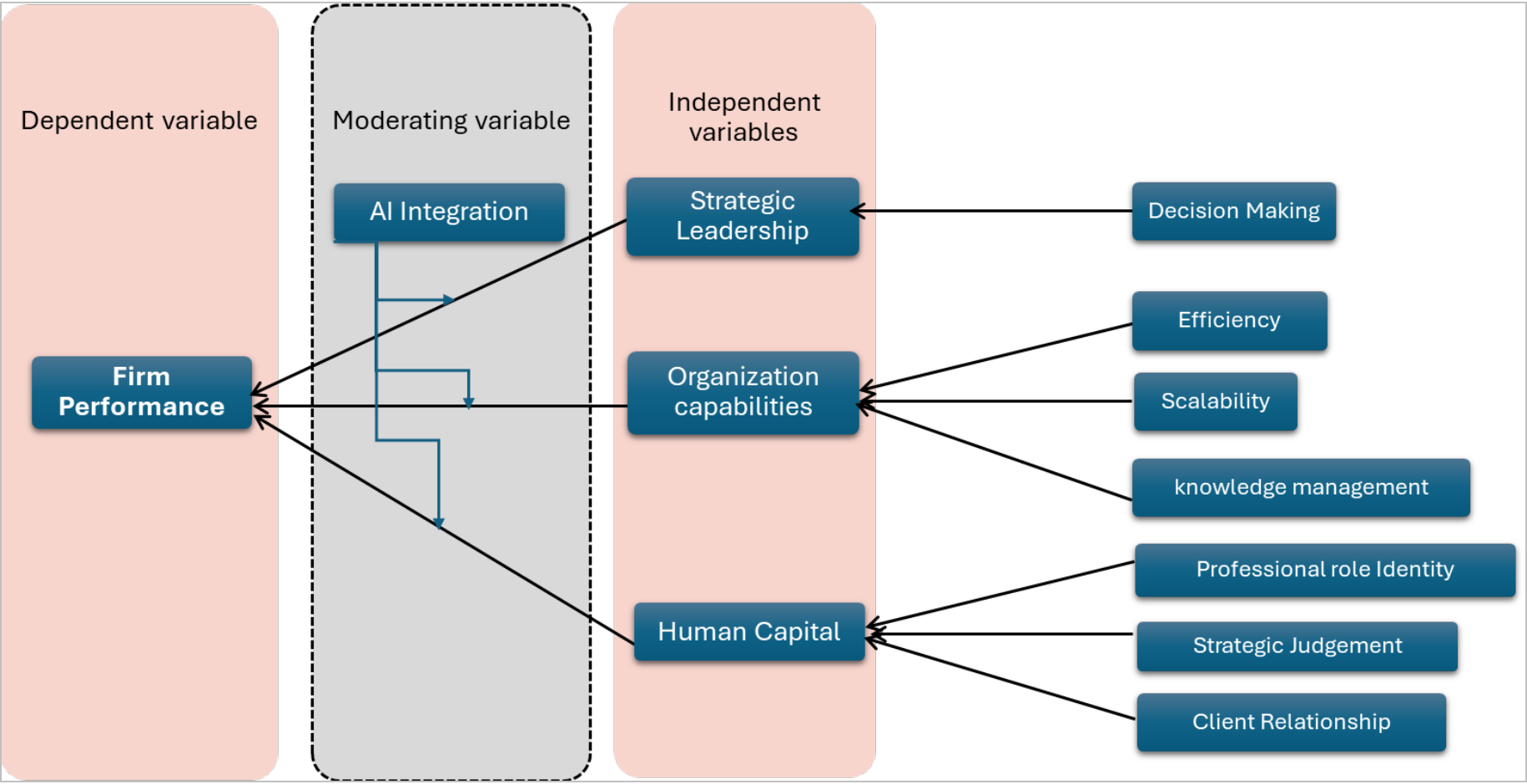
Research consistently shows that AI adoption success follows a progressive path, where each stage builds upon the previous one. These stages don't operate independently, each stage enables and acts as force multipliers for the next, creating a compound effect where early investments in fundamentals pay dividends as you advance. My research was based on:
a. Identifying Business Use Cases
Your organization's ability to identify genuine problems where AI provides meaningful advantage is the stepping stone or the starting condition that provides momentum and direction to your AI journey. You don’t want to insert AI just anywhere in your business, you need to understand the business deeply enough to recognize where AI's unique capabilities could add value. Can pattern recognition, prediction, automation, or generative AI solve problems that traditional approaches cannot?
b. Organizational Capabilities
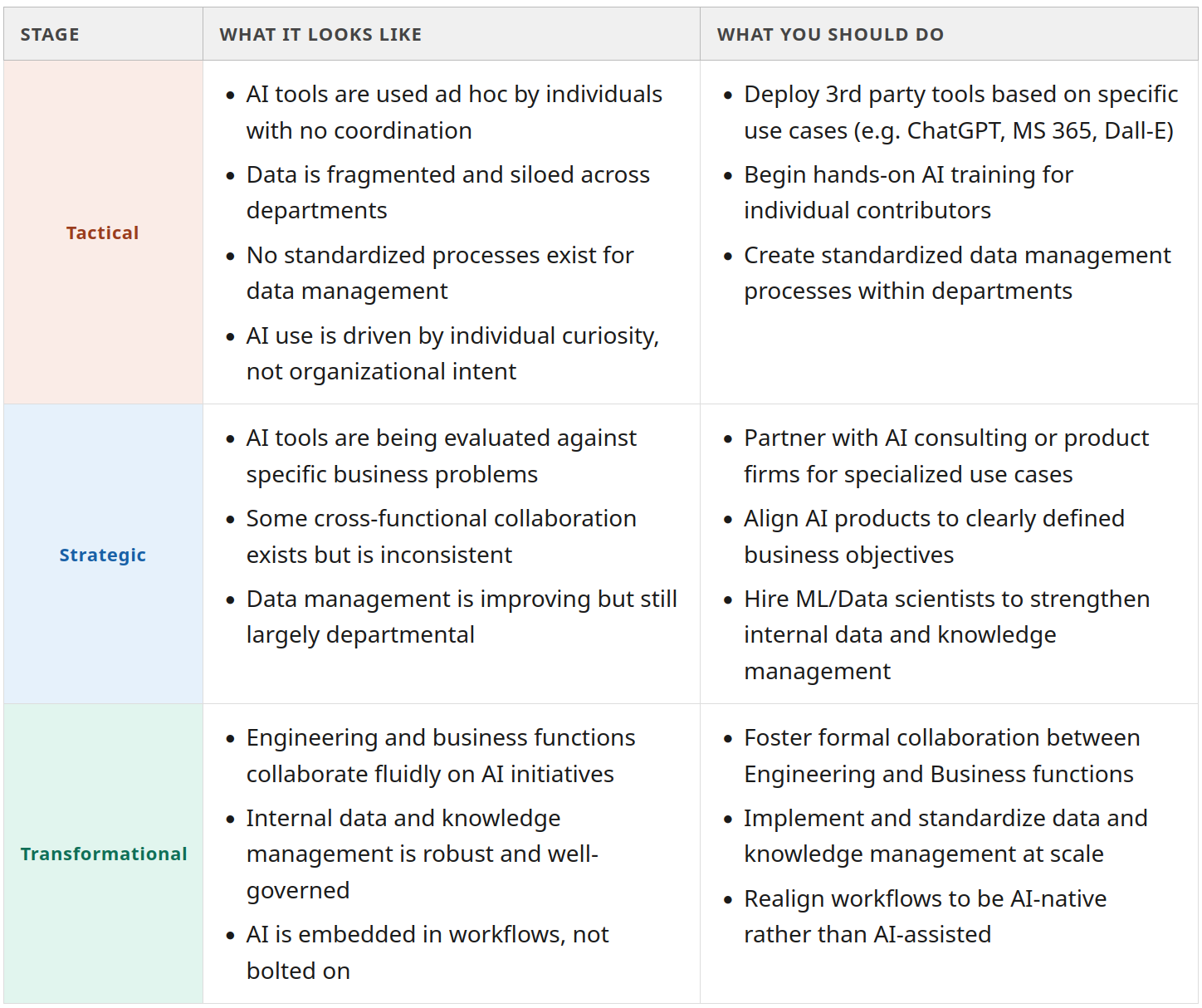
Your organization's technical infrastructure, data maturity, process sophistication, and ability to integrate new technologies. This includes data quality and availability, technical infrastructure, process documentation, change management capabilities, and measurement systems. Organizations with strong capabilities can move from concept to production efficiently, but those without will struggle even with perfect use cases. Keep in mind that your team must have the flexibility to gather data, evaluate it, assess their current situation, and alter course if necessary.
c. Strategic Leadership
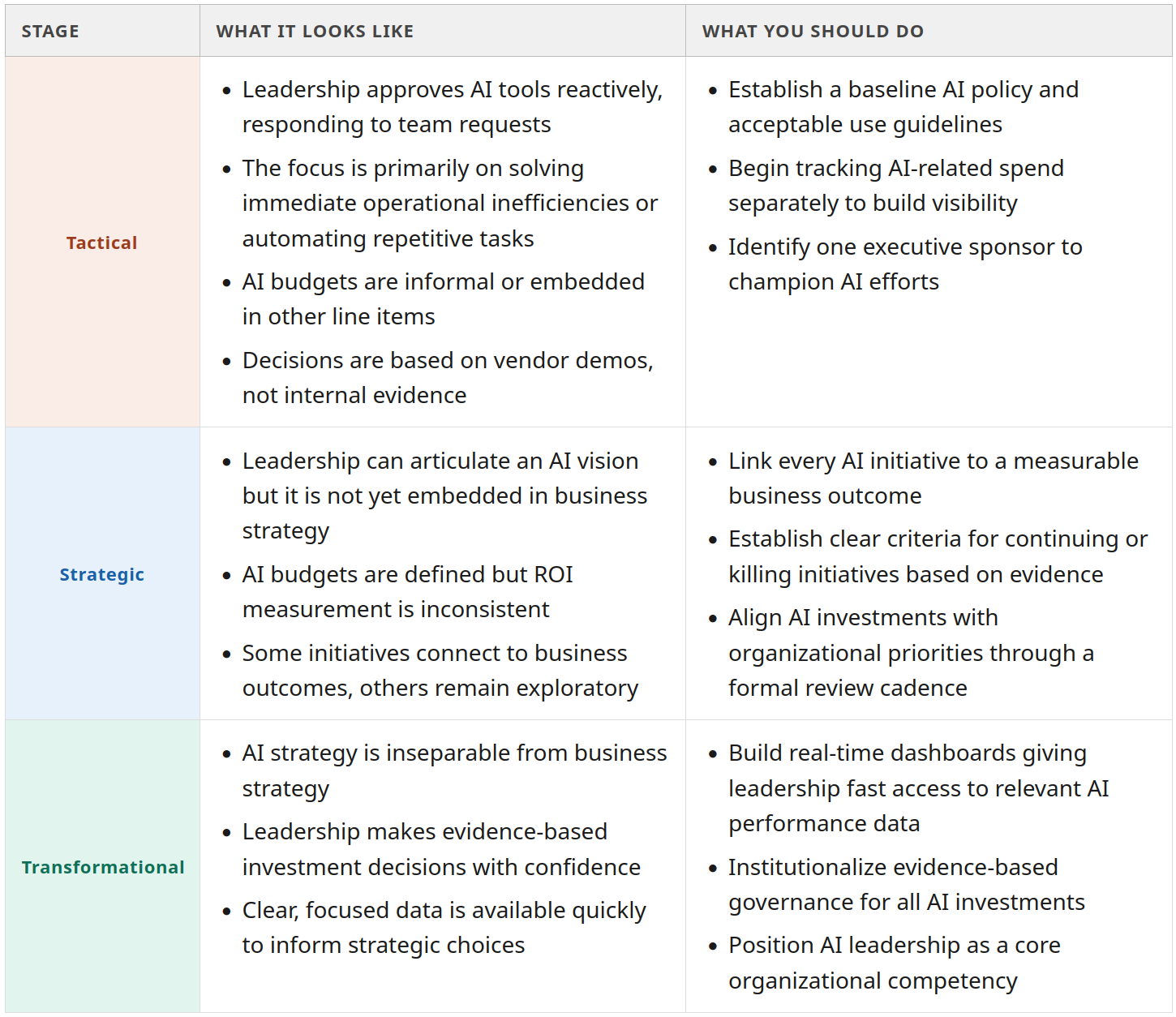
Leadership that understands AI's role as a means rather than an end, can articulate clear vision, allocate resources effectively, and make evidence-based decisions about continuing or killing initiatives. Strategic leadership connects AI initiatives to business outcomes and ensures investments align with organizational priorities. How can leadership devise effective strategies? Its by having clear, focused, and relevant data available quickly.
d. Human Capital
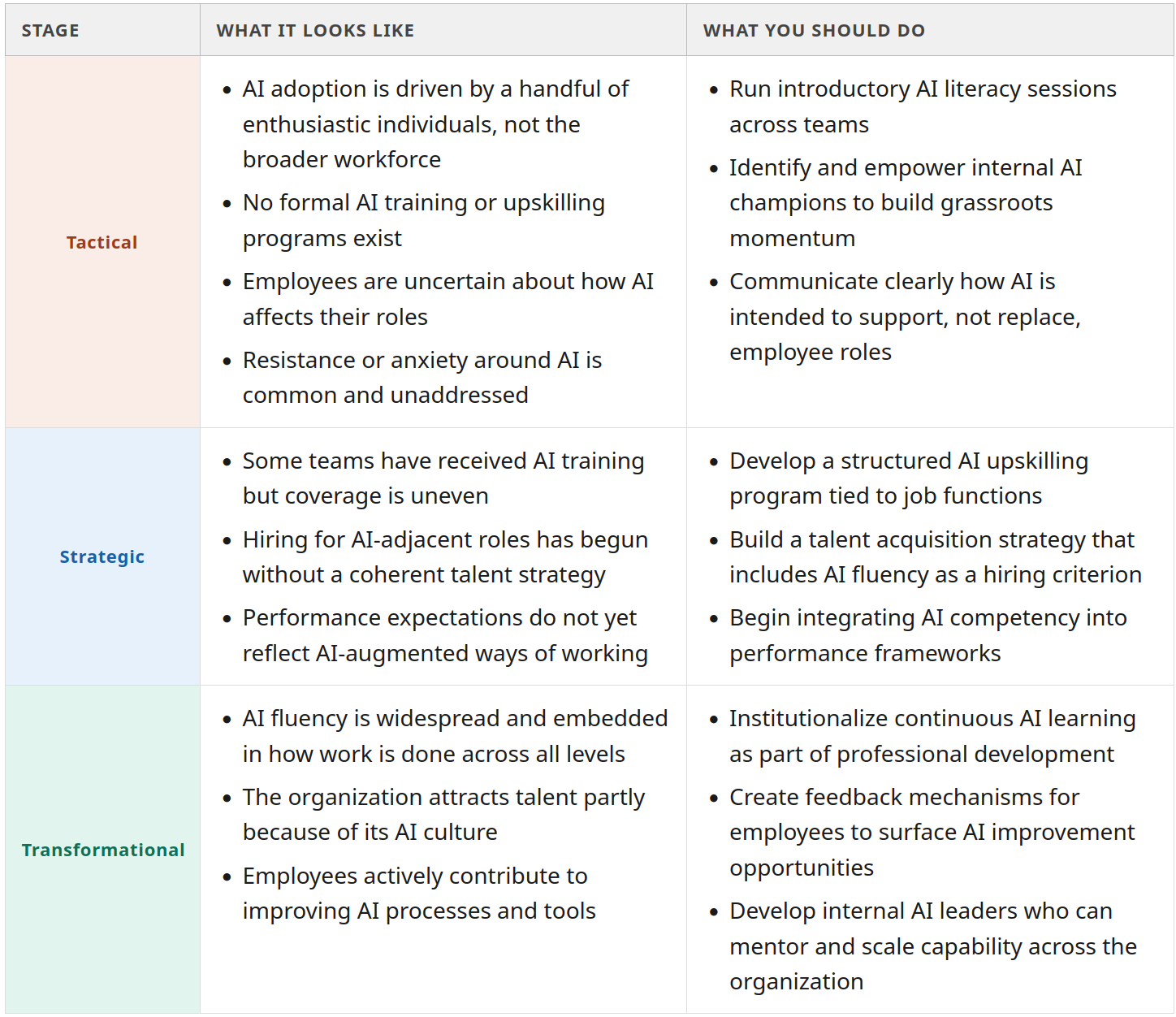
Finally, Your team's skills, adaptability, and capacity to work with AI systems. This encompasses technical skills, domain expertise, learning agility, and psychological safety to experiment and fail. Human capital is the most significant long-term success factor. Ironically, AI is seen as way to cut cost by reducing workforce. But even the best AI systems require skilled people to deploy, monitor, improve, and guide AI systems towards goals that generates values.
One will notice how each of these factors are not only dependent but also act as force-multipliers to others. It is designed like a servo-mechanism, Just like Missiles once launched with a set goal or target can learn from its current state and correct itself while approaching its target at tremendous speed, so can your team. But choosing the right target is key!
How Does the Impact Look Like?
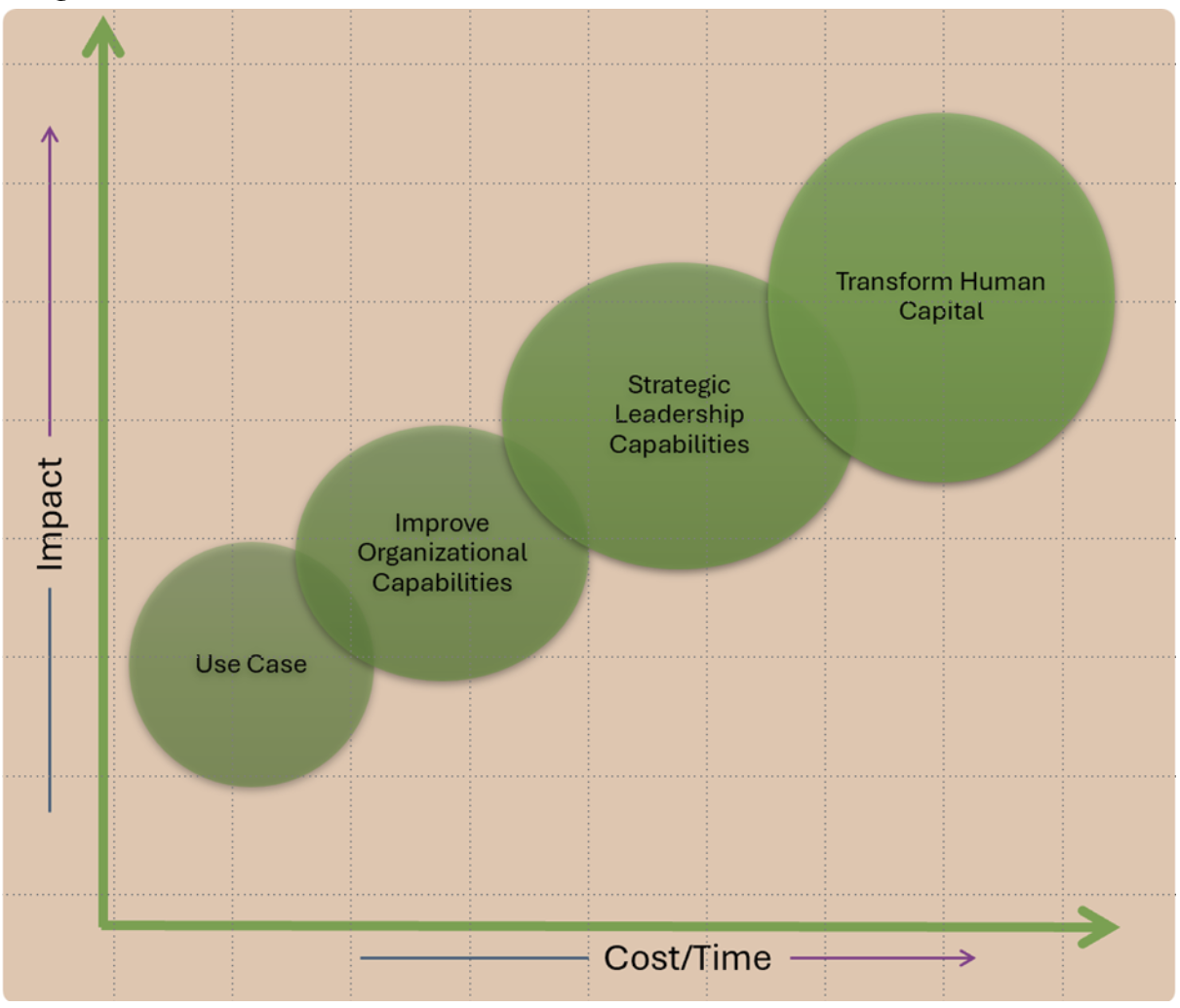
This model reveals a crucial insight: AI adoption is not about implementing all four stages simultaneously. It's a journey where:
- Each stage requires the previous stage as foundation: You cannot transform human capital effectively without strategic leadership in place, which requires organizational capabilities, which requires clear use cases.
- Investment and impact compound: Early stages require less investment but enable later stages. The small investment in use case identification makes the moderate investment in capabilities more efficient, which makes the substantial leadership investment more effective, which maximizes the return on human capital investment.
- Circle size reflects scope of change: Smaller circle means lower investment and consequently lower overall impact while bigger circle indicates higher investment and higher impact. Use cases affect specific projects. Organizational capabilities affect multiple projects. Strategic leadership affects entire business units. Human capital affects the entire organization's future potential.
- Only adjacent stages overlap: This represents the natural progression where you're building the next stage while still optimizing the current one. Organizations that try to jump from Stage 1 to Stage 4 without building Stages 2 and 3 almost always fail.
Organizations should assess where they currently are in this progression and focus on building the next adjacent stage, not jumping ahead to transformation.
Assessing Your Organization
Before moving forward, honestly evaluate your position in each area: Business Use Case Identification (Rate 1-5)
- Can we articulate specific problems AI would solve?
- Do we understand our customers' needs deeply?
- Have we validated these needs with customers?
- Can we measure whether a solution succeeds?
Organizational Capabilities (Rate 1-5)
- Is our data organized, clean, and accessible?
- Do we have technical infrastructure for AI workloads?
- Can we Identify risks involved in implementing AI systems?
- Do we have processes for monitoring and maintaining systems?
Strategic Leadership (Rate 1-5)
- Does leadership understand AI's and its role as a tool?
- Can we make evidence-based go/no-go decisions?
- Do we have clear criteria for success before starting?
- Are we willing to kill initiatives that aren't working?
Human Capital (Rate 1-5)
- Do we have people with relevant technical skills?
- Do our teams combine technical and domain expertise?
- Can our organization learn and adapt quickly?
- Is there psychological safety to experiment and fail?
Scoring Guide:
- 16-20: Strong foundation for AI adoption
- 12-15: Selective adoption with focused capability building
- 8-11: Foundation building phase, tactical experiments only
- Below 8: Premature for AI adoption, focus on fundamentals
Part 2: Generating Use Cases - The Design Thinking way!
Once you've assessed your organizational readiness, the next step is generating potential AI use cases. This requires divergent thinking that is expansive, unconstrained exploration of possibilities without immediate judgment or filtering. I feel most of my time goes into managing stakeholders, usually(but not restricted to) from the top management, who have ideas about integrating AI into anything and everything. Most do not consider, forget the technical feasibility, even the financial implication of these decisions. how much is it going cost per LLM call? how about the added infra cost? how important is data security? have you considered the cost of man hours required to manage these services? So, I cannot stress this enough, have a clear business use case for implementing AI. Ideas can come from anywhere, so don't restrict your process to only management. In-fact, ideas or changes that come from the bottom-up are more likely to succeed during the implementation phase.
Facilitating Divergent Thinking Sessions
As a leader the keyword here to remember is Facilitate. Don't "give" your ideas. Listen and just steer conversations into productive sessions. Gather cross-functional teams including:
- Customer-facing teams (sales, support, success)
- Operations and process owners
- Product and engineering
- Finance and analytics
- Leadership (as participants, not evaluators)
Session Structure (2-3 hours):
- Frame the Challenge (15 minutes)
- "How might AI help us serve customers better?"
- "Where do we waste time on repetitive, rule-based work?"
- "What decisions do we make that could benefit from better predictions?"
- "What information is trapped in unstructured data?"
- Silent Ideation (20 minutes)
- Everyone writes ideas individually
- No discussion, no filtering
- Quantity over quality
- Wild ideas encouraged
- Round-Robin Sharing (30 minutes)
- Each person shares one idea at a time
- No critique or discussion (Very Important)
- Capture everything on sticky notes or digital board
- Build on others' ideas (Very Important)
- Clustering (20 minutes)
- Group similar ideas together
- Identify themes and patterns
- Name each cluster
- Elaboration (45 minutes)
- For each cluster, develop 2-3 specific use case descriptions
- Include: What problem it solves, who it helps, what success looks like
Key Principles:
- Defer judgment completely during divergent phase
- Encourage building on ideas rather than competing
- Document everything! even "bad" ideas can spark good ones
- Focus on problems, not solutions ("we need to predict churn" or "we need to improve lead times" not "we need a neural network" or "we should use AI chat bots for customer service to reduce lead times")
The Convergent Phase: Design Thinking
With a broad set of possibilities generated, shift to convergent thinking using design thinking methodology: Ideate → Prototype → Test.
Ideate: Refining Concepts Take your clusters of use cases and refine them into structured problem statements:
Template:
- Problem: Specific challenge faced by specific stakeholder
- Current Impact: Cost in time, money, or customer satisfaction
- Desired Outcome: Measurable improvement. I.e what will success look like.
- AI's Role: Why AI specifically is needed vs. traditional solutions
Prototype: Rapid Experimentation For promising use cases, create minimum viable prototypes(MVP):
- Use existing AI tools/APIs before building custom solutions.
- Start with synthetic data or small data samples.
- Focus on core functionality, ignore polish.
- Timeline: Days to weeks, not months.
A key mistake that a lot of teams end up making is that they caught up in the "product", they get too attached to the idea of the product rather than the goal. do not try to make this into your "baby". Drive fast (and leave a sexy corpse). Create a prototype to be able to quickly assess its usefulness.
In this stage most will realize that they probably don't enough data or that they need to engineer data pipelines.
Test: Validate Assumptions
Test prototypes with real users and real scenarios:
- Does it actually solve the problem?
- Is the AI necessary, or would a simpler solution work?
- What's the real accuracy/performance vs. requirements?
- Would End-users actually use this?
This divergent-convergent cycle helps organizations generate creative possibilities while quickly filtering for viability.
Part 3: Selecting the Best Use Case
After generating and refining use cases, organizations face a critical question: Which project should we pursue first? Choosing poorly wastes resources and damages confidence in future AI initiatives. Choosing well builds momentum and organizational capability.
I suggest evaluating use cases across three dimensions: Business Impact, Technical Feasibility, Resource Availability
a. Business Impact
The potential value delivered if the use case succeeds. Consider both positive impact (revenue increase, cost savings) and negative impact avoided (churn reduction, risk mitigation).
Evaluation Questions:
- What's the quantified financial impact? (Be honest and conservative)
- How many customers or users does this affect?
- Does this solve a critical pain point or a minor inconvenience?
- Does success here open doors to other opportunities?
- What's the strategic value beyond immediate ROI?
Scoring (1-10 scale):
- 9-10: >$500K annual impact or mission-critical customer problem
- 7-8: $200K-$500K annual impact or significant customer problem
- 5-6: $50K-$200K annual impact or moderate customer problem
- 3-4: $10K-$50K annual impact or minor problem
- 1-2: <$10K annual impact or negligible problem
b. Technical Feasibility
The likelihood that current technology and your organization's current capabilities can successfully implement this use case.
Evaluation Questions:
- Do we have the required data in sufficient quality and quantity?
- Is the technical complexity within our team's capabilities?
- Are there existing tools/APIs or must we build from scratch?
- How well-defined is the problem? (Vague problems are harder to solve)
- Have others solved similar problems successfully?
Scoring (1-10 scale):
- 9-10: Proven solutions exist, data readily available, low complexity
- 7-8: Established approaches exist, data available with minor work
- 5-6: Viable approaches exist, data requires moderate effort
- 3-4: Experimental approaches, data requires significant effort
- 1-2: Research-stage approaches, data doesn't exist or requires creation
c. Resource Availability
The resources required vs. what you can realistically allocate without compromising core business.
Resource Categories:
- Data: Availability, quality, volume, accessibility
- Monetary: Budget for tools, infrastructure, external expertise
- Human: Team time, skills, availability
- Time: Urgency vs. realistic timeline
Scoring (1-10 scale):
- 9-10: All resources immediately available, low ongoing requirements
- 7-8: Most resources available, modest additional investment needed
- 5-6: Moderate resources available, significant investment needed
- 3-4: Limited resources, requires reallocation from other areas
- 1-2: Resources not available, requires substantial new investment
Visualizing the Selection
Map your use cases on a 2D graph where:
- X-axis: Technical Feasibility (1-10)
- Y-axis: Business Impact (1-10)
- Circle Size: Resource Availability (1-10) - larger circles = more resources available
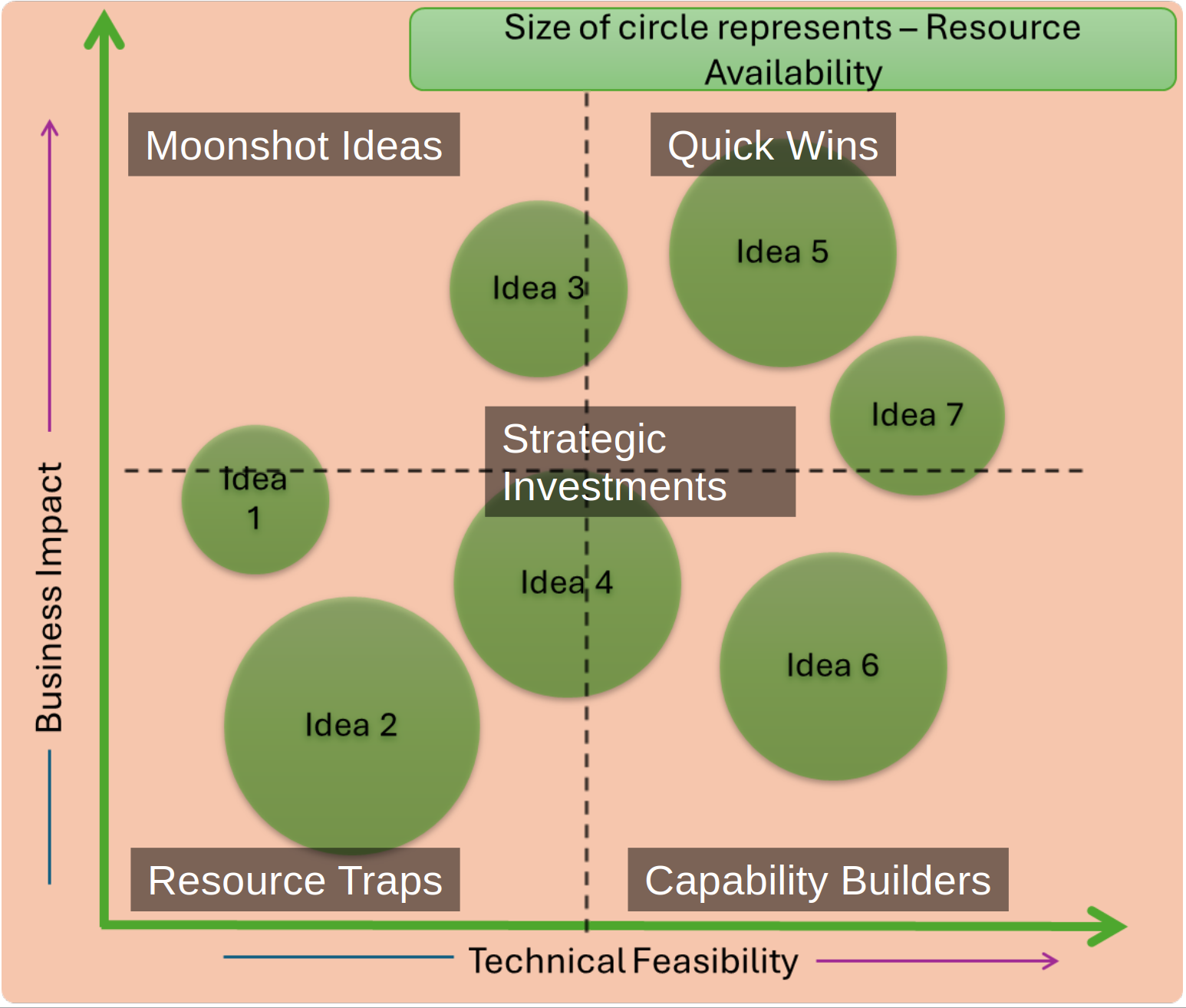
This visualization makes optimal choices clear:
| Priority | Description | What it looks like? |
|---|---|---|
| p1 | Quick Wins | High Business Impact + High Technical Feasibility + High Resource Availability. These are your "start here" projects that build momentum and confidence |
| p2 | Strategic Investments | High Business + Impact Medium Technical Feasibility + Medium Resource Availability. Worth pursuing after quick wins prove organizational capability. |
| p3 | Capability Builders | Medium Business Impact + High Technical Feasibility + High Resource Availability. Use these to build team skills and organizational processes. |
| avoid | Resource Traps | Any combination with Low Resource Availability. These will stall and demoralize teams regardless of other factors. |
| avoid | Low-Value Experiments | ow Business Impact regardless of other factors. Success here doesn't matter; failure here wastes resources. |
| defer | Moonshots | High Business Impact + Low Technical Feasibility. Revisit after capability building, but don't start here. |
Making the Decision
After plotting use cases:
- Identify your Priority 1 (Quick Win) candidates
- Select 1-2 to pursue (resist the urge to do more simultaneously)
- Document why others weren't chosen (avoid re-litigating later)
- Set clear success criteria and timeline (typically 2-3 months for first initiative)
- Commit to honest evaluation (evidence-based go/no-go decision at timeline end)
Part 4: Aligning with AI Maturity
We classify an organization's AI readiness into 3 phases: Tactical, Strategic, and Transformational Phases. Not all organizations are ready for the same type of AI initiatives. Attempting transformational AI projects without tactical experience is like trying to run a marathon without learning to walk. The AI maturity model helps organizations choose initiatives aligned with current capability while building toward greater ambition.
Building on the three organizational domains we identified in Part 1, this section examines how each one evolves across maturity stages, from early tactical adoption through to genuine transformation
Organizational Capability
 Strategic Leadership
 Human Capital
Matching Initiatives to Maturity
Use this alignment guide:
| Your Maturity | Initiative Timeline | Investment Range | Risk Tolerance | Expected Outcome |
|---|---|---|---|---|
| Tactical | 1-3 months | low | High (expect some failures) | Learning and few wins |
| Strategic | 3-6 months | Medium - High | Medium (more wins than losses) | Clear ROI and Capability |
| Transformational | 6-12+ months | High | Low (high success rate) | Competitive advantage |
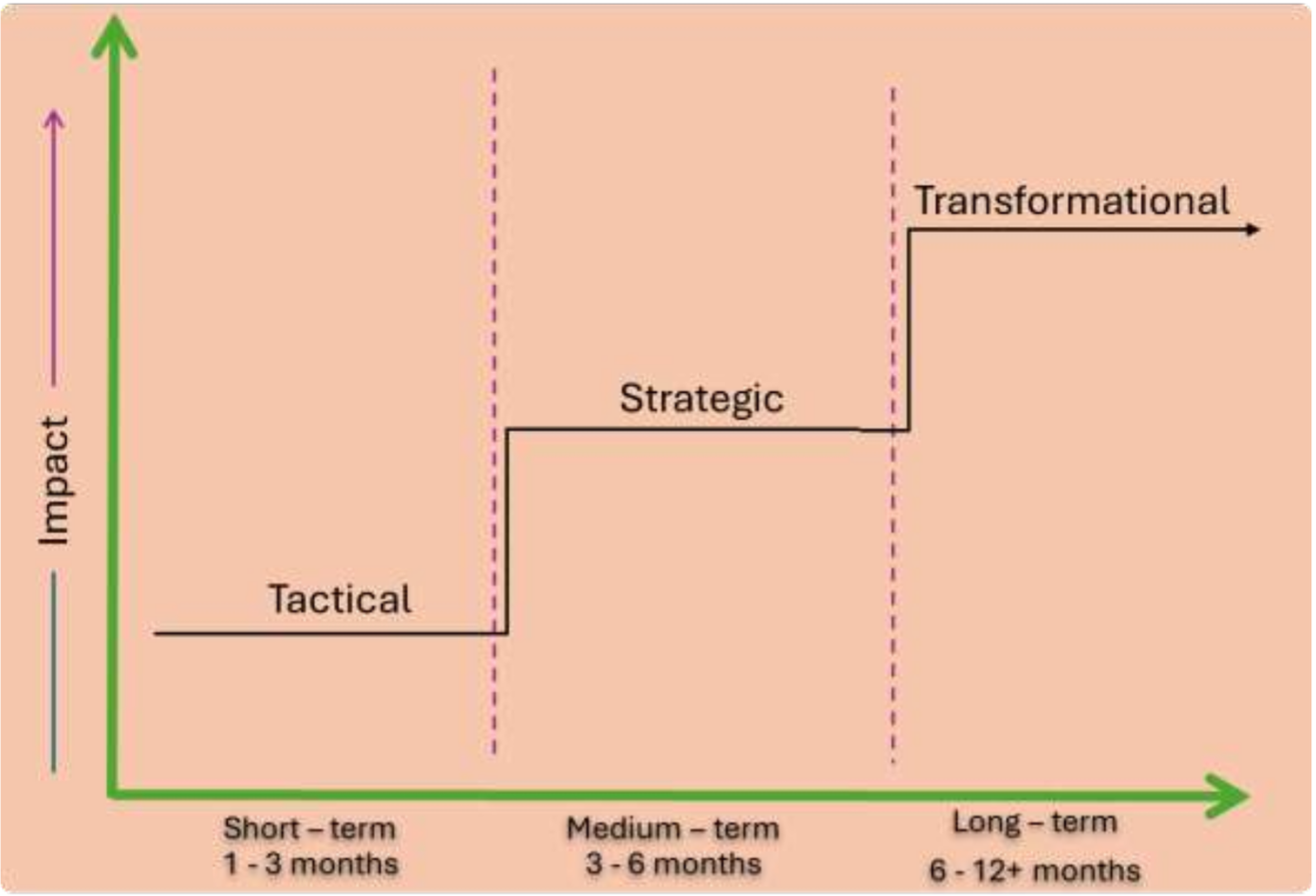
Critical Rule: Don't skip phases. Each phase builds the foundation for the next. Organizations that attempt transformational initiatives without tactical and strategic experience almost always fail expensively and publicly.
Conclusion
Successful AI adoption for SMEs isn't about having the most sophisticated technology, it's about having the right strategy for your organization's context.
The Framework in Practice:
- Assess your organizational readiness across all four pillars
- Generate use cases through divergent thinking
- Select strategically using the three-parameter framework
- Align chosen initiatives with your AI maturity phase
- Execute with clear metrics and honest evaluation
- Learn from each initiative to progress to the next phase
Organizations that move thoughtfully through tactical and strategic phases build the foundation for genuine transformation. Those that skip steps chase transformational outcomes with tactical capabilities and burn resources without building real value. And when there is no real ROI, what follows is predictable: blame, pressure on employees, and eventually job cuts dressed up as progress. These short-term gains are the opposite of transformation because within a few months it is business as usual, just with new people doing the same things.
Start where you are. Build what matters. Define and Measure success, Learn continuously. The goal is not to implement AI, Think of it as building a more capable organization that uses AI as one tool among many to deliver exceptional value to customers.