
Building Engineering Teams That Outlast Their Members (UAE)
Building engineering teams that outlast their members is crucial for long-term success. In the UAE's dynamic tech landscape, fostering a culture of knowledge sharing, mentorship, and continuous learning can help create resilient teams that thrive even as individual members come and go.
Building Engineering Teams That Outlast Their Members
I remember about this resignation that landed in my mail, January, last year. By the following weekend, I understood exactly how much of our payments system lived in one person's head and nowhere else.
He wasn't even a full-time employee. He was a contractor, eighteen months into a rolling engagement, and somewhere in those eighteen months he'd quietly become the only person who understood why a particular reconciliation job behaved the way it did at 2 AM under load. That wasn't an exception on this team, it was the pattern. One engineer was the de facto master of our settlement flows. Another owned the fraud-scoring rules end to end and could explain edge cases nobody else had ever seen. A third had personally led our PCI DSS implementation and carried the whole compliance map in his head: which data was tokenized, which systems sat inside the cardholder data environment and which were scoped out, and why. Each of them was brilliant. Each of them was also a single point of failure we'd never named out loud.
The contractor's agreement had a 30-day exit clause. We spent the first ten days in denial, the next ten in frantic knowledge-dump sessions, and the last ten discovering all the things we'd forgotten to ask. Three weeks after he left, the job did its 2 AM thing, and nobody in the room knew why.
If you run an engineering team in this part of the world, you already know the shape of this. Most of your team is on a visa tied to the job. People come for a few good years, then leave for Europe, for a bigger offer in Singapore, for a startup back home, or simply because their family situation changed.
For years I treated this as a retention problem, something to be minimised. Lower the churn, extend the tenure, hold on tighter. That framing was wrong, and it cost me. The contractor who left wasn't a failure of retention. People leaving is the normal operating condition here, not the exception. The real failure was that I'd built a system that assumed he'd stay. And the numbers I'd later come across only confirmed how structural that mistake really is.
Less Than Half Your Team Is Actually Yours
Here's a number that put hard data behind the hunch. In KPMG's latest 2026 UAE tech report, permanent internal staff make up just 51% of the average UAE organization's core technology capacity today and that's projected to fall to 43% within two years.
The rest is already a patchwork: 26% external contractors and consultants, and a fast-growing slice of AI agents, RPA and bots that the same report expects to climb from 23% to 35% of capacity over the same period.
Sit with that for a second. The mental model most of us still run, that an engineering team is a stable group of full-time employees who stick around, describes less than half of what's actually building your software. The other half is rotating contractors, project specialists, and increasingly, automated agents that nobody onboards and nobody does an exit interview with.
This isn't a culture problem you fix with foosball tables. It's structural. The UAE's expat-heavy, project-driven, AI-accelerating market doesn't produce teams that stay. It produces teams that rotate. And the report says that rotation is going to get faster, not slower.
So the question I started asking stopped being "how do I keep people longer?" and became a more useful one: how do I build a team where any single member leaving, human or otherwise, is a manageable event, not a quiet emergency?
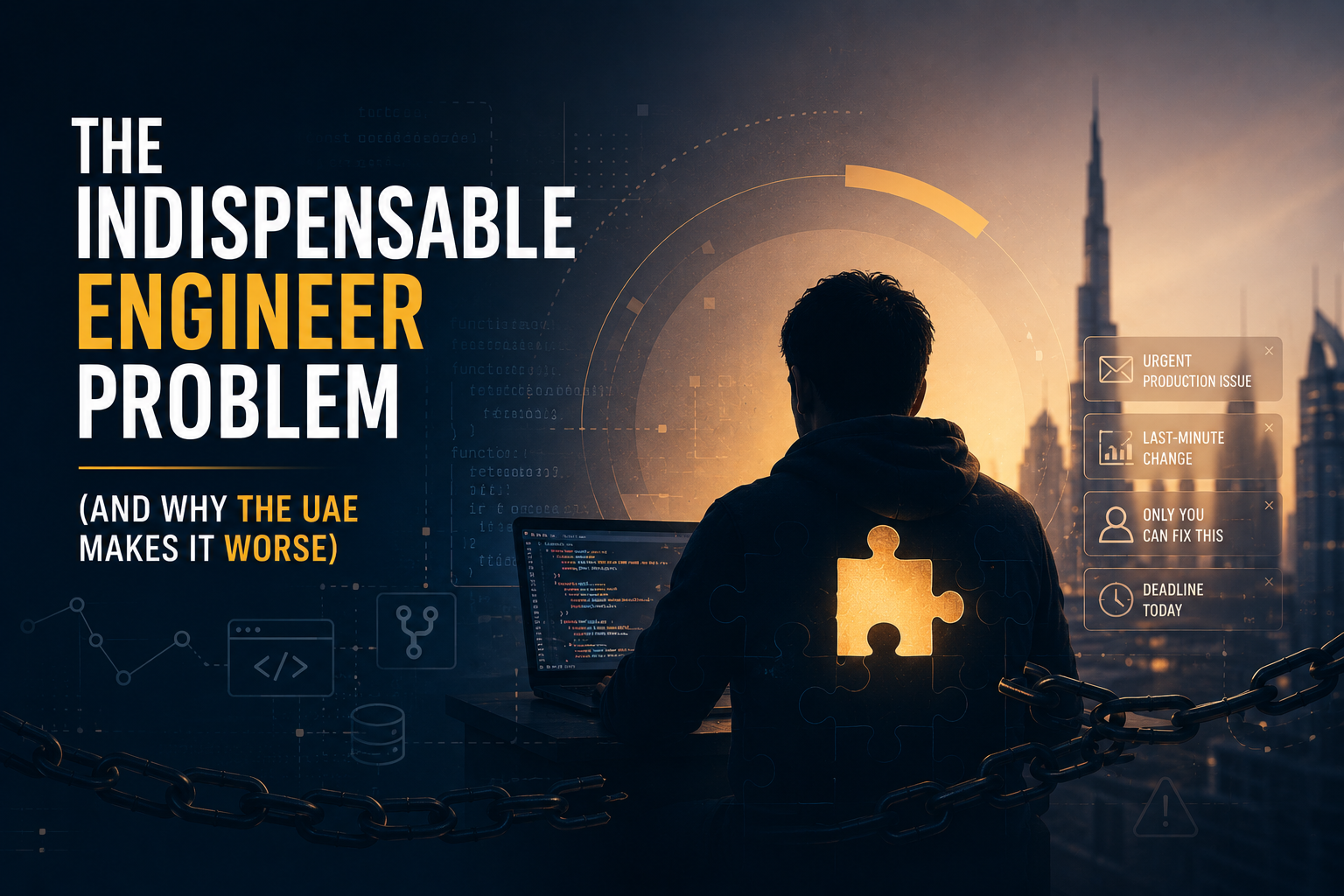
The Trap of the Indispensable Engineer
The indispensable engineer feels like an asset. Founders love them. They're fast, they own their domain, they fix things before you've finished reading the alert. But indispensability is just concentration risk wearing a cape. Every piece of knowledge that lives in exactly one head is a single point of failure with a notice period attached.
And in a market where over half your capacity is non-permanent, that risk isn't an edge case anymore. It's the baseline. The teams that survive churn well aren't the ones with the best people. They're the ones where the best people's knowledge doesn't walk out the door with them.
KPMG put a phrase on it that I haven't been able to shake. The report tells UAE leaders to "treat organizational knowledge as strategic currency" and to institutionalize rapid learning loops and shared knowledge. Currency. Not paperwork, not nice-to-have documentation. The thing that holds its value while the people holding it keep changing.
Why This Is Harder Here Than Anywhere Else
Here's the part that took me longer to see. The churn isn't just a byproduct of the expat market. It's partly state-designed.
The UAE's technology agenda is top-down in a way most Western markets aren't. National mandates (the UAE AI Strategy 2031, We The UAE 2031, Centennial 2071) don't just set aspirations. They actively direct which technologies organisations adopt and at what pace. That's what produces the 69% fast-follower rate in the KPMG data. It's not caution. It's the rational response to a system where the government picks the winning platforms and organisations adopt proven versions of them. Nobody moves first when the state moves for you.
The same framework is what's driving the 54% of UAE organisations planning to hire more onshore tech talent in the next year, well above the global 36%. That's not a preference. It's a sovereignty response: data residency requirements, reduced dependence on adversarial-country tech vendors, compliance kept in-house. The state is mandating local hiring while simultaneously mandating a pace of technology change that local talent pipelines can't keep up with.
Both levers are being pulled at the same time, by the same hand.
The result is a skills gap that compounds the churn. The tech stack is mandated to evolve fast: new AI tooling, new compliance frameworks, new integration requirements every cycle. But the pool of people who understand that evolving stack, locally available and cleared for the right data environments, is genuinely small. Organisations are competing hard for a narrow set of profiles, and when they find someone, they know full well that person is being recruited by three other companies at the same time.
This is why knowledge concentration happens in the first place. When talent is scarce, you take what you can get, you give that person ownership to keep them, and before long they own more than any single person should. The indispensable engineer naturally semms like a predictable outcome of a tight market given macro enviroment. But that doesn't absolve leadership of the responsibility to see it happening and act on it, right?
Five Things That Actually Worked
After that incident, we rebuilt how the team handles knowledge. Not with a heroic documentation sprint that everyone abandons after two weeks, but with practices that make resilience the default path rather than an extra chore.
1. Knowledge transfer is continuous, not an exit interview
My biggest mistake was treating knowledge transfer as something that happens when someone leaves. By then it's too late, you're extracting eighteen months of context in 30 days while the person is already mentally gone. We moved it upstream. The test I use now: if any contributor vanished tomorrow with zero notice, how bad would it be? If the answer for anyone is "catastrophic," that's this quarter's problem, not their last week's.
2. Rotating ownership, deliberately
Single ownership manufactures the indispensable engineer. So we rotate it on purpose. Critical services have a primary and a secondary owner, and every quarter someone takes a turn owning a module they didn't build. It's slower in the short term, an engineer in unfamiliar code is less efficient than the author. But that's the premium you pay so that no single departure can take down a system. In a market where 26% of your team is on a contract clock, it's the cheapest insurance you'll buy.
3. Onboarding that compresses time-to-productivity
If people cycle through every couple of years, the speed at which a new contributor becomes genuinely productive is one of the most important numbers in your org. KPMG found UAE leaders rank skills and talent as the single most critical success factor for technology strategy, and 54% plan to hire more onshore talent in the next year, well above the global 36%. Everyone is fishing in the same pool. The org that ramps a new hire in weeks instead of months wins that competition by default. We now treat onboarding as a system with a measurable output: time-to-first-meaningful-contribution.
4. Documentation as a culture, not a deliverable
Everyone wants documentation; almost no team has it, because it's always the thing you'll do after the deadline. The fix wasn't a mandate, it was making documentation a byproduct of how we work: short design notes before building anything substantial, decision records that capture why not just what, and a rotating practice where each sprint one engineer walks the team through a module they didn't write. That last one does double duty: it spreads understanding and it surfaces, in real time, exactly which parts of the system only one person understands. The blank stares in the room are your risk map.
5. A living knowledge base the team didn't have to build by hand
This one we added after the January incident, and it's the one I wish we'd built first.
We set up a lightweight internal knowledge base wired to a RAG pipeline. The feeds aren't documentation anyone writes deliberately; they're the artefacts the team already produces: Slack threads where someone debugged a tricky problem, meeting notes captured automatically by an AI notetaker, email chains where architectural decisions got hashed out. The system ingests all of it, indexes it, and makes it searchable in plain language. When a new engineer asks why the settlement service retries the way it does, they don't need to find the person who remembers. They query the knowledge base.
Alongside that, we run an agent that works through legacy code and database schemas and generates documentation for them: what a table holds, what a service does, what the non-obvious assumptions are. It's not perfect. It still needs a human pass for anything compliance-critical, especially anything touching the PCI DSS scope. But it compresses what used to be weeks of archaeology into hours.
The honest insight here: most of the knowledge that lives in people's heads got there through conversations, not documentation sessions. Capturing those conversations automatically, as a background process, is the only realistic way to keep that knowledge in the system when the person leaves.
The AI Twist Nobody's Onboarding For
There's a wrinkle the KPMG numbers make impossible to ignore. The fastest-growing part of your team isn't human. AI agents and bots are set to jump from 23% to 35% of tech capacity, and 93% of UAE organizations now build AI-native roles into their hiring.
We onboard people. We do not, as a rule, onboard agents, and we certainly don't do knowledge transfer when we swap one model or tool for another. Every automated workflow that "just works" until it doesn't is the contractor who left without documentation, except it never had a notice period at all. The same discipline, known owners, written rationale, a rollback plan, no single point of understanding has to extend to the non-human half of the team too. Otherwise you've just moved the indispensable-engineer problem somewhere even harder to interview.
Culture Is the Lever You Actually Control
You can't control whether people leave. The visa, the family, the bigger offer, the contract end date, the model deprecation, those are mostly outside your reach. What you can control is whether your team is structured so that leaving is survivable.
And here's what surprised me: a team that outlasts its members is also a team people want to stay in. Engineers who aren't trapped as the sole owner of a fragile service are less stressed. People who can take a real vacation without their phone exploding are more loyal. Distributed knowledge and lower churn turn out to be the same project from two different angles.
The transient workforce isn't a curse to be managed. It forced us to build something more honest: a team whose strength lives in the system and the culture, not in any one irreplaceable person or tool. When less than half your capacity is permanent and that share is shrinking, that's not a defensive move. It's the only version of a team that survives.
So here's the question worth sitting with: if your most knowledgeable contributor, the contractor, or the agent disappeared tomorrow, would it be a manageable transition, or the quiet emergency you've been one departure away from this whole time?