
Cognitive Atrophy: The Hidden Cost of AI in Engineering Teams
AI tools delivered real velocity gains but, behind the sprint charts, something quieter was happening. Developers stopped proofreading their own code, stopped reading the codebase, and reached for AI to rename a variable. The habits that make engineers exceptional were eroding faster than the credits were burning.
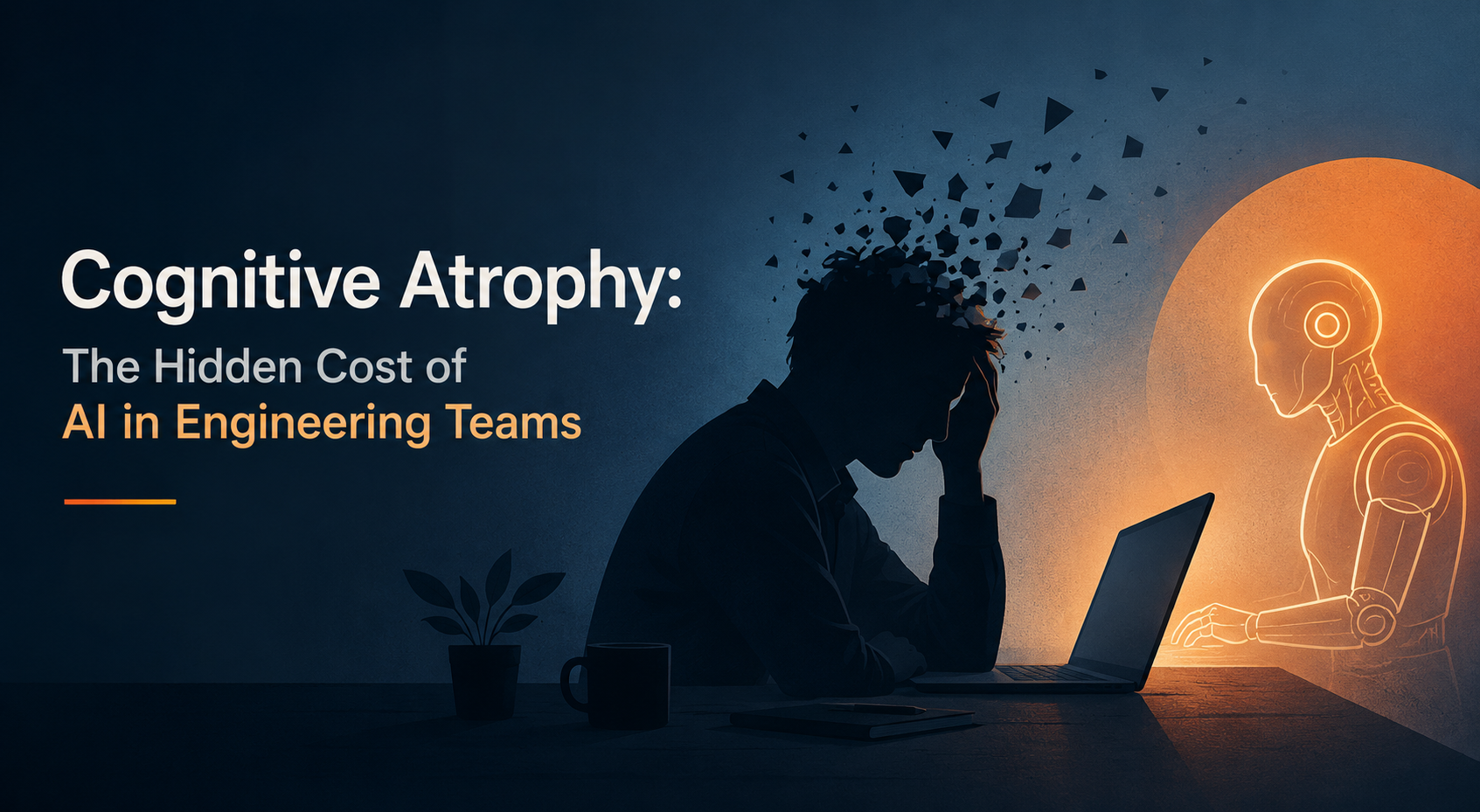
Cognitive Atrophy: The Hidden Cost of AI in Engineering Teams
When we first integrated AI-assisted coding into our SDLC, the results looked exactly like the brochure promised.
Developers were finishing tasks faster. Sprint velocity charts that had flatlined for months were suddenly climbing. And then something interesting happened: planning became the bottleneck.
For the first time in years, our engineering team was outpacing our product roadmap. We couldn't assign work fast enough to keep developers busy. It felt like we'd finally cracked the code on productivity.
So we leaned in harder.
We refined the AI workflow, tightened the CI/CD pipeline, and optimised the handoffs between planning and development. We were engineering our own efficiency engine. And for a few months, it worked beautifully.
Then we looked at the bills.
The Hidden Meter Was Running
We were burning through AI credits at a rate nobody had anticipated. So I did what any reasonable engineering leader would do: I dug into the usage data to understand where the spend was going.
What I found was not what I expected.
Developers were using AI to rename variables. To change constant values. To write single-line conditional statements that any engineer should produce in under thirty seconds.
The same tools that could architect a microservice, generate an entire test suite, or explain a complex algorithm were being used as an expensive autocomplete for the most trivial tasks imaginable.
But that wasn't the part that concerned me most.
Three Signals I Should Have Caught Earlier
Signal 1: The AI review loop
Our AI-powered code review tools were flagging the same categories of mistakes, repeatedly, across different developers. Not complex architectural issues but silly mistakes. Missing null checks. Unreachable code. Variable shadowing. The kind of errors an engineer catches when they re-read their own work before anyone else sees it.
We were running multiple review iterations per PR, consuming credits, because developers had quietly stopped proofreading their own code. Why would you? The AI would catch it.
Signal 2: The duplicate code explosion
When AI generates code, it doesn't always know what already exists in your codebase. Sometimes it does, sometimes it doesn't. It solves the problem in front of it and moves on. If a near-identical solution already exists in another module, it has no way to know unless you explicitly tell it.
Developers who deeply understand a codebase develop an instinct for this, they've read the code, they know roughly what lives where. That instinct was quietly disappearing. Reading the codebase had become unnecessary when you could just generate something that works and ship it.
The result: significant duplication that we only discovered when we added yet another tool specifically to detect it.
Signal 3: The trivial task dependency
When developers reach for AI to change a constant value, it's not because the task is difficult. It's because the habit of just doing the small thing yourself had atrophied. The cognitive path of least resistance had shifted from "do it" to "prompt it."
The Irony That Stopped Me Cold
Here's what made me sit back: every single problem we were spending money to solve had an existing solution.
- AI credits burning on trivial tasks → coding standards and discipline
- Multiple AI review cycles catching basic mistakes → pair programming and self-review habits
- Duplicate code proliferating silently → code ownership, module awareness, architectural standards
These were not new problems requiring new solutions. They were old problems that old practices had already solved, for free (maybe not completely free... nothing is), for decades.
We had spent months optimising an AI workflow that was quietly dismantling the engineering discipline that made the workflow valuable in the first place.
The Deeper Question
The AI credits were measurable. I could see them on an invoice.
What I couldn't put on an invoice was the question that started to bother me more: what else is being quietly lost that I can't measure?
Because the trivial task dependency and the vanishing self-review habits showed up in tooling data. But there are other things...things that develop slowly in an engineer over years, that don't appear in credit usage reports.
The diagnostic instinct. The ability to sit with a broken system and reason through it methodically, without outsourcing the thinking to a tool. The architectural intuition that comes from having read thousands of lines of other people's code and genuinely understood why decisions were made.
These take years to build. And they can erode surprisingly quickly when the environment stops demanding them.
I'm not suggesting we abandon AI tools. The velocity gain was real. The ability to onboard new languages and frameworks faster is genuinely valuable. These are legitimate wins.
AI has also done something real for team composition: it's narrowed the gap between a mediocre programmer and a good one. A developer who struggled with syntax, boilerplate, or unfamiliar frameworks can now produce working code significantly faster. That's a real levelling of the playing field.
But if you're building a small, high-output team, the kind that outpaces companies ten times its size, what you actually need isn't just people who can code. You need engineers who genuinely enjoy creating things and solving problems. That drive is something AI can't replicate, and it's increasingly what separates teams that build things worthwhile from teams that just generate code.
It's also worth being honest about where AI actually falls short. It's excellent at generating code. It can kickstart thinking when you're staring at a blank screen, help you explore a solution space, or compress the time from idea to first prototype. These are real capabilities.
But forward-looking work, deciding what to build next, anticipating how a decision today will constrain your options in eighteen months, inventing an approach that doesn't exist anywhere yet for a model to have learned from, that's still fundamentally human work. AI is a powerful executor. Not a creative strategist.
Which raises a harder question than the one on the invoice: has adding AI, and its costs, actually solved the problem that matters most? The problem of finishing things quickly has had workable solutions for decades. You could always throw ten developers at a sprint backlog, or get three exceptional engineers in a room with a deadline and some pizza and ship something. Output speed was never the unsolvable problem.
The genuinely hard problem is building something valuable over the long term. That requires thought, taste, and accumulated judgment about what is worth building and why. I haven't found that AI has moved the needle there, and it may even, in the ways described above, be quietly eroding the conditions that make that kind of work possible.
I've started asking a different question in planning conversations:
Are we getting faster at "building" software that generates value, or just faster at generating code?
Because these are not the same thing. And the gap between them is exactly where technical debt lives.
What We Changed
We didn't roll back the AI workflow. Instead, we restructured how we work so that better engineering behaviour becomes the natural path. Not by blocking AI use, but by building in steps that keep the thinking where it belongs: with the engineer.
- Reintroduced pair programming for complex features, not because AI can't assist with complexity, but because two engineers reasoning through a problem together is where architectural intuition gets built and transferred.
- Codebase orientation as part of onboarding, new engineers spend their first two weeks reading existing code before writing any. With AI, this step had started to disappear because you could be productive without it. We brought it back deliberately.
- Think before you generate. Before writing substantial code with AI assistance, engineers write a short approach note: what they're building, which existing code it touches or reuses, and why this approach over alternatives. It takes five minutes. It's reduced duplicate implementations, and more importantly, it puts the engineer in the driver's seat before the AI enters the picture.
- Rotating codebase walkthroughs. Each sprint, one engineer presents a module to the team, ideally one they didn't build themselves. The goal isn't a lecture; it's distributed understanding. It keeps the "what lives where" instinct alive across the whole team and makes reading the codebase a normal part of the job, not something that only happens when something breaks.
The Question for Your Team
Velocity is a measure of output speed. It tells you how fast code is leaving your team. It says nothing about what happens to that code six months later.
If your developers are finishing tasks faster but you're seeing increasing review cycles, rising technical debt, and a codebase that's harder to navigate than it was a year ago, the AI workflow may be part of the reason.
The tools are not the problem. The assumption that faster output equals better engineering is.
What is your team measuring, and what are you quietly not measuring?